
Plants / Closed humid displays
Plants for a closed terrarium: choose for care access
Choose a foreground, a textured mat, or an upright accent, then match growth and maintenance to your humid glass landscape.
By Terrarium GuideSources & editorial method
The short answer
For an openable closed humid terrarium, choose by the role you need: compact Fittonia for patterned foreground leaves, Selaginella kraussiana for a low textured mat, Pilea for upright foliage, or a verified compact fern for frond structure. RHS also lists Peperomia caperata cultivars and Pilea microphylla as closed-terrarium choices. Compare their growth and actual fit rather than filling the bottle with every candidate.
Use bright indirect light, moist draining roots, and a lid you can open for water adjustment and trimming. Flowering Episcia is a more hands-on choice because leaves must not stay wet and runners and spent flowers need access. A lid alone does not diagnose poor internal circulation, and a humidity-loving plant still needs a maintainable root zone.
Choose the role before combining plants
| Plant or choice | Decision | Management you must allow |
|---|---|---|
| Compact Fittonia albivenis | Patterned foreground leaves with room to spread. | Verify a compact form; pinch shoots and keep an inspection edge. |
| Selaginella kraussiana | A fine-textured low mat around, rather than over, other crowns. | Keep moist drained roots and a reachable boundary; trim spread before it covers a neighbor. |
| Pilea cadierei | Upright silver-marked foliage where more headroom is available. | Pinch and renew tall growth; keep leaves uncrowded and off wet glass. |
| Peperomia caperata cultivars · RHS closed-terrarium list | A rounded, textured foliage accent rather than a carpet. | Choose the named cultivar by eventual height and spread. NC State describes soil drying between waterings: use a reachable separate draining pot if the surrounding bed stays moist, and inspect the rootball before watering. |
| Pilea microphylla · RHS closed-terrarium list | A small-leaved contrast to broad Fittonia or Peperomia leaves. | Provide indirect light and moist draining roots; keep its mat reachable to trim. NC State describes 15–30 cm height and spreading growth: tiny leaves do not promise a static outline. |
| Compact lemon button · RHS N. duffii / Duffii entry | An upright frond clump for a wider, taller growing space. | Allow its documented 10–50 cm height/spread band and unfolding fronds; keep good ventilation and avoid wet foliage. |
| Episcia cupreata | A flowering foliage accent for a gardener who can maintain it. | Keep leaves dry, roots drained and runners reachable. Remove finished flowers; use a more open layout if wet crowded foliage persists. |
Evidence[16][17][1][5][9][8][19][20]
- Choose the compact fern, not an unspecified young sword fern Compare the horticultural form, name differences, and real headroom.
- Plant and contain the Selaginella mat Keep its spreading stems out of neighboring crowns.
Scope and important limits
A useful fit when
- Choosing rooted plants for an openable closed humid container.
- Comparing actual light, growing space, moisture and maintenance access.
Use another path when
- A permanently airtight system or guaranteed survival duration.
- Extending a partly open combination assessment to closed conditions.
Plant needs come from horticultural sources. The planting advice applies those needs to an openable humid display; no site growing trial is claimed.
A lid does not make a dim position suitable
- Compare lower-light choices and their limits Separate preferred indoor light from tolerance, then choose a usable position.
- Improve the light before planting Choose daylight, supplemental light or a dedicated growing light.
A creeping mat, textured leaves, or a frond clump?
These are different roles, not a planting recipe. Choose the one your light, root zone and maintenance access can support.
- A fine branching ground layer
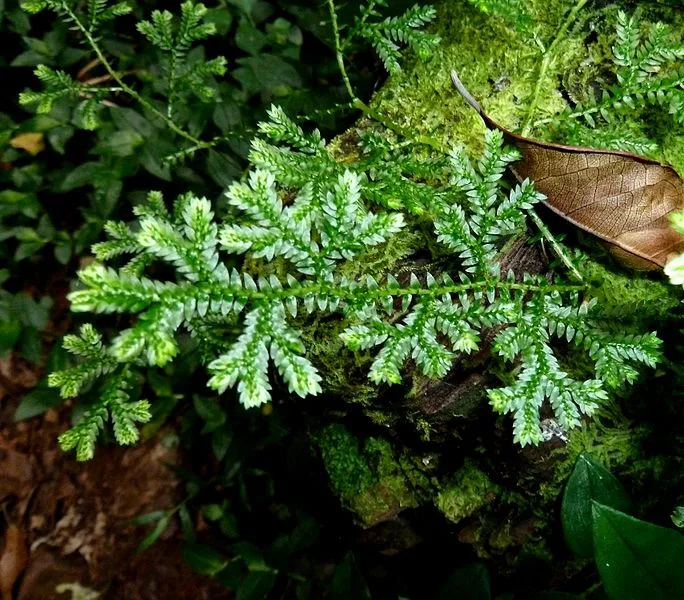
The branching mat belongs to Selaginella kraussiana, a rooted spikemoss. Keep a reachable edge; this is not a photograph of true moss or a tested mixed planting. Image: JMK · CC BY-SA 3.0 - Compare Selaginella kraussiana
Its low mat spreads across the surface; fine foliage does not mean a fixed footprint.
- Check
- Can you keep shallow roots moist but draining, with indirect light, humid air and an edge you can reach?
- Action
- Set the roots into suitable medium, keep green growth above it, and trim advancing stems before they cover neighboring crowns.
- Stop or reassess
- Use a separate reachable patch or another layout if spread cannot be controlled; do not use standing water to compensate for dry air.
- A named textured-leaf cultivar
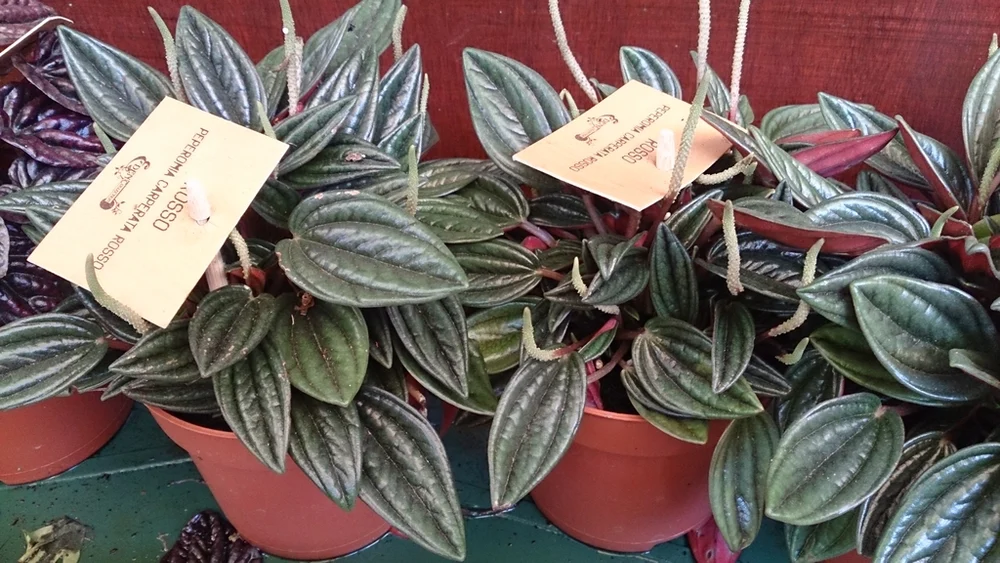
This gallery photograph shows plants labeled Rosso, a narrow-leaved Peperomia caperata form. Cultivars differ in leaf shape and size; choose the actual plant and its root-watering routine. Image: Mokkie · CC BY-SA 3.0 - Compare Peperomia caperata by form and root care
RHS lists caperata cultivars for closed terrariums, but their leaf shape, eventual size and watering must be checked individually.
- Check
- Does the actual cultivar fit, and can you inspect its rootball separately from a continually moist surrounding bed?
- Action
- Use a reachable draining inner pot where the bed stays too moist. Check the rootball before watering; the source describes drying between waterings.
- Stop or reassess
- Choose another root setup if soil remains wet or the pot cannot come out. The pictured Rosso labels do not identify an unlabelled purchase.
- An upright fern silhouette
- Verify the compact lemon-button form
The RHS N. duffii / Duffii horticultural entry offers a different frond structure from a creeping mat or broad foliage clump.
- Check
- Allow for the source’s 10–50 cm height and spread band, the actual fronds, ventilation and removal access.
- Action
- Confirm the form before buying, provide bright filtered light and moist draining compost, and leave room for unfolding fronds.
- Stop or reassess
- A young sword fern or mini trade label does not establish the compact form or a fit in your bottle.
Evidence[17]
Keep the complete conditions with Fittonia, Pilea, or Episcia
If you choose one of these foliage plants from the comparison, retain all its conditions below. Their care is shown in text here; the different growth forms above help you compare the wider choice.
Candidates for these conditions
Conditional fit
Fittonia albivenis
A conditional candidate when the actual plant fits and the lid opens for inspection, air exchange, and maintenance. The source’s explicit terrarium recommendation applies to dwarf forms; it does not establish long-term enclosed performance for every retail plant.
Read the plant profileCompact nerve plant in an openable closed display
An openable closed humid display with bright indirect light and moist, freely draining rooted substrate. Measure actual conditions and retain inspection, trimming, and removal access. These are the conditions to check in your display, not results from a long-term sealed growing trial.
A low foreground plant sized to the specimen; the explicit terrarium recommendation is limited to dwarf forms.
- Planting zone
- Moist but not waterlogged rooted medium; share only where member requirements overlap.
- Check at the plant position
- Light at the canopy; Usable floor area and headroom; Root-zone drainage and watering method
Required care and access
- Measure the actual plant and available space. For the source’s explicit terrarium use, choose a verifiable dwarf form.
- Maintain bright indirect light and a moist, freely draining root zone.
- Retain an opening for maintenance and inspect actual leaf and medium conditions. Do not impose a fixed lid-opening schedule.
Conditional fit
Pilea cadierei
Sources list closed-terrarium use, but high humidity and poor air circulation increase powdery-mildew risk. Use only a maintainable vessel that opens for inspection, avoids standing water, and allows crowding to be controlled.
Read the plant profileAluminum plant with accessible leaf and air checks
An openable closed humid display with bright indirect light and moist, freely draining rooted substrate. Measure actual conditions and retain inspection, trimming, and removal access. These are the conditions to check in your display, not results from a long-term sealed growing trial.
Required care and access
- Provide bright indirect light and a moist, freely draining root zone.
- Retain lid access and check air and leaf conditions.
- Avoid persistently wet leaves and thin crowded growth promptly.
Conditional fit
Episcia cupreata
A conditional flowering accent for a maintainable humid display: keep roots drained, leaves free of lasting wetness, and runners and flowers reachable. Low exchange with the room is not itself evidence of poor air movement among leaves. Move to a more open layout if persistent wetness or crowding cannot be corrected.
Read the plant profileFlame violet with dry foliage and reachable runners
An openable closed humid display with bright indirect light and moist, freely draining rooted substrate. Measure actual conditions and retain inspection, trimming, and removal access. These are the conditions to check in your display, not results from a long-term sealed growing trial.
An accessible flowering foliage accent in the humid rooted zone.
- Planting zone
- Moist, freely draining rooted medium; keep water off the leaf canopy.
- Check at the plant position
- Lid and removal access; Space around the leaf canopy and runners; Day and night temperatures
Required care and access
- Provide warm bright indirect light and moist, freely draining roots; check actual day and night temperatures against the species guidance.
- Keep leaves off wet glass and water the root area instead of repeatedly wetting the foliage.
- Keep lid and removal access, remove spent flowers and decay, and control runners and crowded growth.
- Inspect leaves and medium; open the lid when excess moisture or air movement needs adjustment. Move to a more open humid layout if adverse conditions persist.
Check the container at the plant position
- Indirect light without glass heating in direct sunAssess the canopy position, not just the room. Move the display if direct sun falls on enclosed glass.
Evidence[13]
- Moist medium with no persistent standing waterCheck the rooted layer before adding water. Gravel can collect water inside glass; it does not provide an outlet for excess water.
Evidence[4]
Choose one carpet before filling the floor
Use S. kraussiana for a rooted, fine-branched mat, or choose living true moss for a surface patch from the moss guide. They have different planting methods: spikemoss has a rooted plant’s substrate needs; true moss must contact its appropriate growing surface with the leafy top exposed.
Baby’s tears can also make a dense green patch, but NC State warns that it can crowd other terrarium plants. For a mixed bottle, the more useful decision is whether you can keep its entire boundary reachable. A separate single-groundcover scene avoids asking a tiny shared floor to accommodate several expanding mats.
A closed-terrarium list is a starting point, not permission to combine every item. For a first mixed scene, assign a low accent and a taller focal role, leave visible growing space, and compare each chosen member’s light, root moisture and temperature. Add no plant merely to fill a gap.
- Place a living moss surface patch Choose a mat or cushion for its actual surface and moisture.
- Read baby’s tears planting and spread control Inspect its moist-root requirements and accessible boundary.
Keep these care routines out of the shared moist bed
| Plant | Conflict | Practical alternative |
|---|---|---|
| Aloe vera | Needs thorough root-zone drying between waterings; a persistently moist bed conflicts. | Use a separate bright, draining succulent display. |
| Spanish moss (Tillandsia usneoides) | A supported epiphyte needing watering followed by drying; it is not a rooted moss carpet. | Use a removable, open support with species-appropriate care rather than the closed planting bed. |
- Compare the display directions Separate humid rooted planting, succulent care, and supported air plants.
Manage what you observe, not a fixed opening calendar
- Excess condensation or overly wet medium
- Check the substrate and foliage as well as the glass.
- Check
- Look for persistent wet foliage or water collecting in the vessel.
- Action
- Pause added water and open the lid to allow excess moisture to dissipate. Recheck before closing.
- Stop or reassess
- Do not keep adding water to a wet planting; reconsider a setup that stays saturated.
- Crowding or growth you cannot reach
- Access is part of the plant choice.
- Check
- Check whether growth blocks neighboring foliage or the route for your tools.
- Action
- Trim accessible growth or remove an outgrown plant. Use another vessel if maintenance cannot be carried out.
- Stop or reassess
- A plant you cannot inspect or remove is a reason to change the arrangement.
Evidence[13]
- Decline despite humid air
- Humidity alone does not identify the cause.
- Check
- Inspect the leaf canopy, root moisture, light, and crowding. Air can move inside an enclosure, as the AOS fan example shows: exchange with the room and movement among leaves are separate checks. That mechanism does not supply an Episcia airflow threshold.
- Action
- Remove decaying material, make space between leaves, and correct excessive root or leaf wetness. Open the lid when adjustment is needed; use a more open layout if the plant cannot be maintained in this one.
- Stop or reassess
- Do not assume wilting always means more water or copy one plant’s needs to every member.
Choose members without claiming a tested closed combination
Evidence[13]
- Follow the complete Fittonia profile Check the actual plant, planting, pruning, companions and ongoing care.
Your next step
- Keep a routine after plantingCheck the growing method, clear dead material, prune appropriately, and reassess plants that outgrow care.
- Assemble the humid gardenPrepare the root zone, plant at the existing level, and inspect after closing.
- Compare a broader open humid plantingConsider independent pots, supported growth and different maintenance goals if the closed options do not fit.
Use your plant shortlist
Before you start
More detail when you need it
- Baby’s tears: planting and careGrow Soleirolia soleirolii with moist roots and humid air. Choose a reachable layout, divide and contain the mat, and check crowding, drying, and regrowth.
- Selaginella kraussiana: planting and careIdentify Selaginella kraussiana, plant its shallow roots, keep moist soil and humid air, trim spreading stems, and distinguish drying from wet-root decline.
- Frosty fern: planting and careIdentify and care for the Selaginella martensii form sold as Frosty fern. Plan humidity, temperature, growing room, root drainage, division, and white-tip checks.
- Plant and maintain aluminum plantCheck upright growth, root care, leaf changes, and reachable pruning.
- Choose and care for FittoniaInspect one candidate in detail before planting.
- Return to plant selectionCompare other display types and growing conditions.
- Sources and editorial methodHow these facts and scenario judgments are prepared.
Explore more in plants
Sources and review
- Fittonia albivenis — NC State Plant Toolbox · NC State Extension
- Indoor Plant Care — Purdue Extension HO-39 · Purdue University Extension
- Fittonia — RHS Plant Guide · Royal Horticultural Society
- Terrariums — MU Extension Guide G6520 · University of Missouri Extension
- Pilea cadierei — NC State Plant Toolbox · NC State Extension
- Pilea cadierei — RHS Plant Profile · Royal Horticultural Society
- Pilea cadierei Aluminum Plant — UF/IFAS Extension · University of Florida IFAS Extension
- Episcia cupreata — NC State Plant Toolbox · NC State Extension
- Selaginella kraussiana — NC State Plant Toolbox · NC State Extension
- Soleirolia soleirolii — NC State Plant Toolbox · NC State Extension
- Aloe vera — NC State Plant Toolbox · NC State Extension
- Tillandsia usneoides — NC State Plant Toolbox · NC State Extension
- How to Create and Care for a Terrarium · Iowa State University Extension and Outreach
- Plants and Youth: Designing and Building a Terrarium · University of Florida IFAS Extension
- WFO Plant List 2026-06 (taxonomic identity) · World Flora Online
- Bottle gardens and terrariums — plant choices, planting and care · Royal Horticultural Society
- Nephrolepis duffii — RHS horticultural profile (including the listed Duffii synonyms) · Royal Horticultural Society
- Air Movement — internal circulation and enclosed growing spaces · American Orchid Society
- Peperomia caperata — root moisture, size and habit · NC State Extension
- Pilea microphylla — terrarium use, moisture and spreading growth · NC State Extension
- Plant of the Week: Episcia cupreata: Flame Violet · University of Arkansas System Division of Agriculture Cooperative Extension Service
- Episcia cupreata — RHS Plant Profile · Royal Horticultural Society
- Episcia cupreata 'Cleopatra' — Flora & Fauna Web · National Parks Board, Singapore