Plants / Selaginella kraussiana
Selaginella kraussiana: plant and contain a humid ground layer
This shallow-rooted spikemoss needs moisture and room to creep, with an edge you can keep visible.
By Terrarium GuideSources & editorial method
Botanical identity: Selaginella kraussiana
The short answer
Selaginella kraussiana is a candidate for a humid terrarium with indirect light and a moist, well-drained root zone. It is a rooted vascular plant, often sold as spikemoss or moss fern, rather than true moss.
Use it where you can inspect shallow roots and trim creeping stems. Dry air can brown the foliage, but keeping roots permanently saturated is not the remedy. A shallow removable pot can make edge control easier.
Evidence[1]
Give the shallow mat a reachable growing surface
| Position | Useful feature | Limit |
|---|---|---|
| Moist humid ground layer | Creeping stems form a low continuous surface. | Leave neighboring crowns and a visible soil edge clear. |
| Shallow removable pot | Matches the shallow root system and allows removal. | Keep roots moist and drain surplus water outside glass. |
| A dry or sunny succulent display | Care conditions conflict. | Choose another plant or a separate humid arrangement. |
| Permanently wet, inaccessible base | Moisture cannot be safely checked or corrected. | Change the root zone and opening before planting. |
Evidence[1]
Scope and important limits
A useful fit when
- Choosing, planting, and maintaining the named plant in the conditions described here.
Use another path when
- Transferring these conditions to an unidentified retail plant or assuming a permanent sealed display.
Published horticultural guidance and its application to display care; no Terrarium Guide growing trial is claimed.
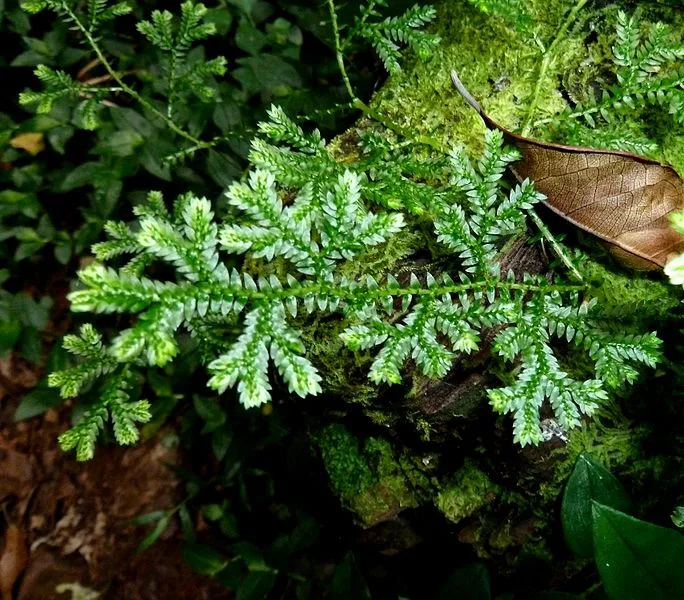
Spikemoss has roots and spreading stems
This profile covers Selaginella kraussiana. Irish moss, cushion moss, and moss fern are overlapping sales names, so retain the scientific label. The Frosty fern profile on this site covers Selaginella martensii; neither the label fern nor a pale tip establishes that the two are interchangeable.
NC State describes ordinary growth about 2–4 in. (5–10 cm) tall and 1–1½ ft (30–46 cm) wide, with rapid spread. Those dimensions explain why a low planting still needs lateral room. They are not a measured terrarium growth rate or a promised adult width in a pot.
Evidence[1]
Check the living tips, rootball, and access
- Inspect the center as well as the edgeLook for dry brown growth, soft decay, and the actual amount of rooted medium under the foliage.
- Keep the nursery medium from drying in transitPrepare the planting position before exposing the shallow roots; avoid leaving a loose clump in a hot sunny window.
- Test your maintenance reachYou must be able to get beneath advancing stems without uprooting every neighboring plant.
- Ask a seller for the named living plant Keep the identity and specimen checks above; compare seller information, arrival forms and delivery before ordering.
Set shallow roots into moist, aerated medium
Moisten the medium gradually
Use a moisture-retentive but well-drained medium. Standing water below glass cannot drain away through a stone layer.
Handle a rooted section gently
Keep the foliage above the surface and place the roots in contact with the prepared medium. Do not bury the green mat or compress it under hardscape.
Leave expansion space
Keep the starting edge visible and clear a route beside other plant bases. A removable pot needs a clear outlet and a rim free of bridging growth.
Check and water at root level
Use room-temperature water when moisture is needed. Inspect beneath the edge again after planting instead of relying on glass fog or automatic daily misting.
- Prepare an accessible humid bed Keep the creeping growth and shallow root zone reachable through the chosen opening.
Check air dryness and soil wetness separately
Provide indirect light and humid air, avoiding direct sun. Check shallow soil frequently enough to catch drying; the relevant observation is moisture where the roots sit. Water a drying root area before the entire mat becomes crisp, then allow surplus water to leave a removable pot.
The source’s moist-to-wet habitat descriptions do not remove its warning about root rot in persistently wet conditions. If the center is soft or the medium is saturated, open the display and inspect the root zone. More spraying is not a response to every brown leaf.
Evidence[1]
Control the edge before it entangles its neighbors
Trace an advancing stem
Trace the advancing leafy stem back into the spikemoss mat before choosing the edge to remove. Keep a neighboring plant’s central growing point and rooted base separate from that stem. Support the patch you will retain. If the plants cannot be separated visually, lift the mat for a closer look rather than cutting across both.
Clip or lift the unwanted edge
Use clean scissors and collect loose pieces. Keep access to the center so a fresh edge does not hide old dead material.
Save healthy material separately if wanted
NC State describes division and rooting stem cuttings in damp soil. Place a rooted division or healthy cutting in its own moist medium, with humid air and indirect light, while you observe new growth.
Move an unmanageable mat
If trimming requires damaging neighboring roots, lift and divide or remove the plant. A different layout is more useful than repeatedly forcing growth into an inaccessible gap.
Evidence[1]
Use the location of browning to guide the check
| Observation | Inspect | Action |
|---|---|---|
| Dry, shriveled outer foliage | Shallow root moisture, room dryness, and direct sun. | Correct a dry root zone or exposed position; review humidity without flooding roots. |
| Soft center in wet medium | Standing water, buried foliage, and dead debris. | Remove dead material and restore a moist, aerated root zone. |
| Healthy stems covering another plant | Where creeping stems contact fresh medium. | Trim the boundary or separate the planting. |
Evidence[1]
- Check moisture beneath the decorative surface Compare the affected edge and center before adding water to an already wet bed.
Use the species guidance at its proper scale
Evidence[1]
Compare conditions and companions
More detail when you need it
Explore more in plants
Sources and review
- Selaginella kraussiana — NC State Plant Toolbox · NC State Extension
- WFO Plant List 2026-06 · World Flora Online
- How to Create and Care for a Terrarium · Iowa State University Extension and Outreach