Materials / Choose the root medium
Terrarium substrate: choose a mix for the roots
Match water retention, air spaces, and ingredients to the growing method before measuring a recipe.
By Terrarium GuideSources & editorial method
The short answer
For ordinary humid foliage, choose a light potting medium that holds moisture while leaving air around roots. A peat-free potting compost amended with horticultural grit is one published starting method. Garden soil, a mineral base layer, and a decorative topping do different jobs.
Drying succulents need freely draining medium and an outlet for water. Epiphytic air plants need a support rather than a soil bed. Carnivorous plants and orchids need a mix for their actual identity; a bag labeled “terrarium soil” cannot establish that match.
Choose the growing method before the mix
| Growing method | Useful starting point | Condition to keep |
|---|---|---|
| Ordinary humid foliage bed | Light, moisture-retentive potting medium with an open structure. | Roots need air too. A lid does not make saturation safe. |
| Open drying succulents | Freely draining medium intended for the identified succulent. | Use a draining pot or removable inner pot; empty runoff. |
| Epiphytic air-plant support | No potting-soil bed; removable cork, branch, or other suitable support. | Water and dry the plant as its own routine requires. |
| Carnivorous planting | Specialist nutrient-poor medium matched to the plant and water quality. | Flytrap, Nepenthes, and butterwort guidance is not interchangeable. |
| Orchid planting | Terrestrial mix or an epiphyte mix/mount, according to identity. | An orchid label alone does not identify the root arrangement. |
- Match a succulent to its drying routine Keep light, drainage, and growth together.
- Distinguish orchid root arrangements Compare terrestrial and epiphytic requirements.
- Choose the carnivorous plant first Check water, nutrients, light, and seasonal care.
Scope and important limits
A useful fit when
- Choosing a prepared medium or understanding ingredients before mixing.
- Checking the limits of a foliage recipe and a separate flytrap example.
Use another path when
- A universal blend for every plant, animal vivarium, or hydroponic growing system.
Published horticultural guidance informs these choices. Examples are not site growing trials or evidence that plants can share a bed.
What substrate does around the roots
Substrate means the material a plant grows in. Potting mix, potting soil, and the British term potting compost often describe prepared growing media; they do not necessarily contain garden soil. Finished garden compost is one possible ingredient, not the same product as a complete potting compost.
The root medium supports the plant and carries water, air, and nutrients. Water fills spaces between particles; persistent saturation leaves less room for air. More organic material or more grit is not automatically better: choose the balance for the plant and the way you can manage water.
For a small terrarium, buy a medium intended for containers instead of digging garden soil. A soil that works outdoors can become too dense in a confined root zone.
Look at structure, then verify the label
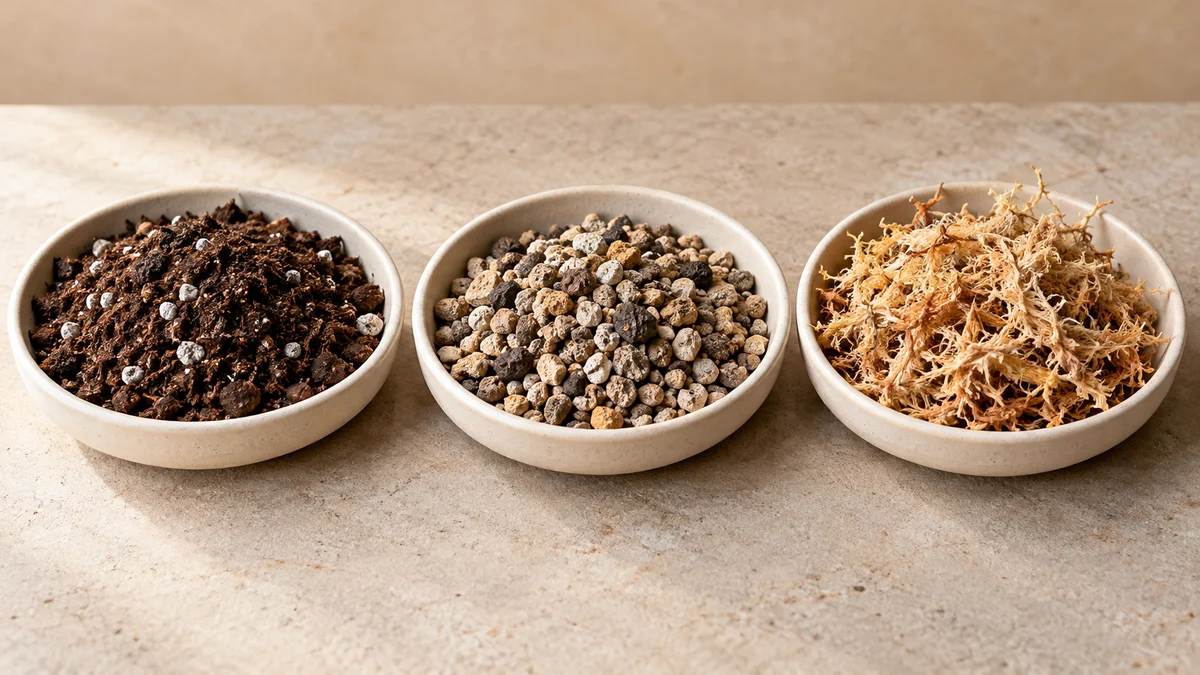
Fibers, fine particles, and coarse pieces help explain structure. Their appearance cannot tell you the pH, salts, or fertilizer in a product.
Compare ingredients by the job they do
| Material | Useful role | Check before substituting |
|---|---|---|
| Coir and wood-fiber blends | Organic components used in peat-free growing media; coir retains water. | Processing and the complete blend matter. Follow the product’s watering and feeding instructions. |
| Composted horticultural bark | Porous organic structure; grades change water and air spaces. | Fine processed bark and coarse orchid bark behave differently; landscape mulch is not a named root mix. |
| Perlite | Lightweight particles used to add air spaces. | Dry material can be dusty. It does not create an outlet in glass. |
| Vermiculite | Water-retentive mineral material. | Do not treat it as a one-for-one replacement for a less water-retentive amendment. |
| Horticultural grit or specified sand | A mineral ingredient in particular published mixtures. | Use the specified grade. Fine decorative sand is not equivalent, and sand alone does not guarantee aeration. |
| Long-fiber sphagnum and sphagnum peat | Distinct materials used in some specialist media. | Long fibers and fine peat are not the same texture or a universal foliage recipe. Check fertilizer and the target plant. |
| Green compost or added fertilizer | A source of nutrients within some prepared blends. | Not an automatic improvement for small slow-growing displays or nutrient-sensitive carnivores. |
- Separate living moss from dried and preserved products Root-medium material is different from living ground cover.
A published starting mix for humid foliage
The RHS terrarium method uses about four parts peat-free multi-purpose potting compost to one part drainage material such as horticultural grit. Measure with the same scoop for a practical small batch, combine evenly, and retain the product information.
This is a foliage starting method, not a formula for every bottle or plant. If you already have a specialist prepared medium suitable for the selected plants, follow its directions rather than automatically adding another amendment. A very different particle grade or base compost changes the resulting mix.
Keep roots, medium depth, and access together. If the mixture or growing method does not suit a selected plant, change the planting plan or keep that plant in a separately managed pot.
- Plant the humid bed in the correct sequence Prepare the vessel, check rootballs, and backfill without burying growth.
Keep specialist mixtures on their own terms
A recipe only makes sense with its plant, ingredient grades, container, and watering method.
Drying succulents: free drainage includes the container
Use a freely draining mix suitable for the identified succulent. A mineral amendment can change the medium, but it cannot remove water from a vessel without holes. A removable draining pot gives you a way to water outside the display and discard runoff.
Evidence[8]
Flytrap example: do not transfer the foliage recipe
ICPS describes sphagnum-based options and a standard equal-parts sphagnum peat and sand mixture for Venus flytraps. It cautions against potentially salty components and connects medium choice with pot height and water level. For this beginner choice, buy a specified unfertilized flytrap medium and follow the full pot-and-water routine.
This is not a recipe for every carnivorous plant. RHS peat-free trial results for stated Sarracenia material also do not establish that an ordinary peat-free houseplant mix suits flytraps or Nepenthes.
Air plants and orchids: check where roots belong
The epiphytic air plants covered by our guide use an open support without potting soil around the base. Orchids are a separate identity decision: terrestrial and epiphytic plants can need very different media or mounts. Do not buy coarse orchid bark for a terrestrial plant simply because both are sold as orchids.
- Set up the draining succulent pot Follow its separate assembly method.
- Read the complete flytrap routine Keep medium, water, pot, and light together.
- Choose an air-plant support Keep it removable for watering and drying.
Prepare the mix in a bowl before filling glass
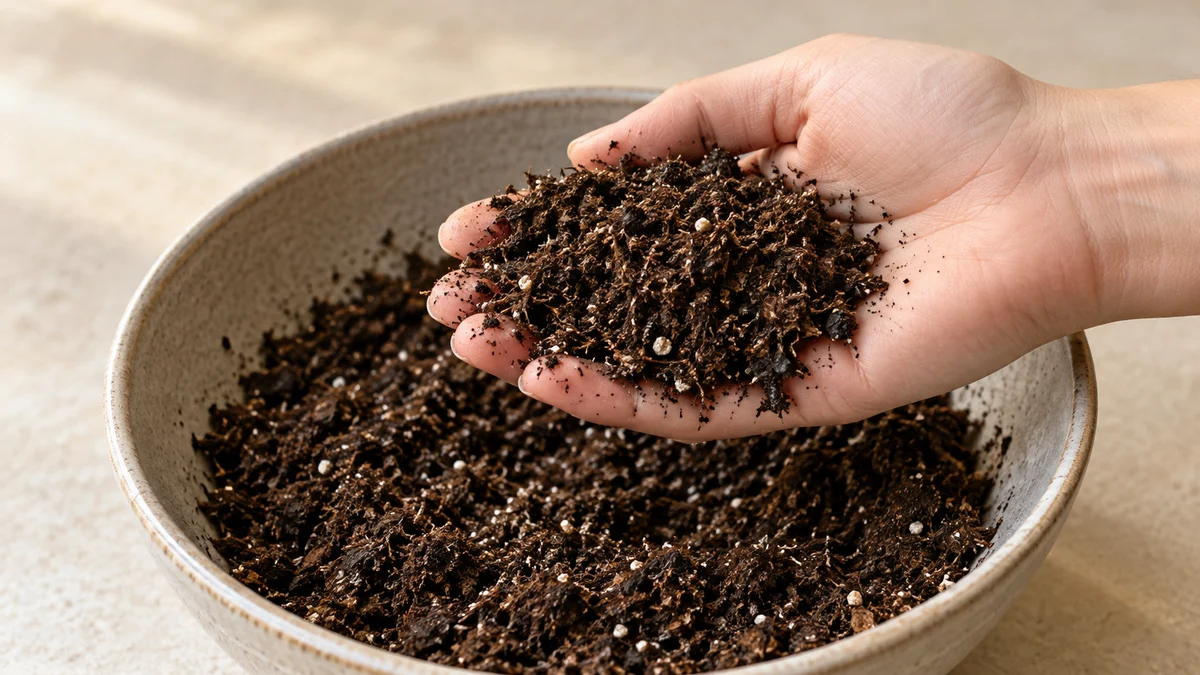
This close view shows a loose sample supported in the palm. Use the handling steps below to check the actual mix; dark color alone does not establish moisture.
Prepare a small foliage batch without compacting it
Use these steps for an ordinary foliage potting medium. Specialist media follow their own plant and product instructions.
Read the product and measure the space
Check intended plants, ingredients, fertilizer, lime, and preparation directions. Compare actual rootballs with the available growing depth; omit optional layers that leave roots too little room.
- Check the bag and its intended job Confirm ingredients and treatment before using it.
Moisten gradually outside the display
Use a clean bowl and follow the bag directions. Work in small additions of water instead of pouring a large amount into the finished glass. Wear gloves when handling the medium.
Evidence[2]
Check a sample, then release it
For the ordinary potting-medium handling check, a lightly squeezed sample can hold together but should break apart easily, with little or no water expressed. Add dry suitable medium if dripping; add water gradually if still dry and difficult to wet. This does not measure air spaces or specialist suitability.
Evidence[4]
Mix evenly and fill without hard packing
Distribute amendments through the growing medium instead of making decorative stripes around roots. Keep the fill loose, then settle it gently around the rootball for support. Avoid pressing it into a dense block.
- Continue with planting and first watering Keep the plant at its existing growing level.
Root depth and a coarse base are different decisions
Size the growing layer around the actual roots and usable vessel height. A universal depth in inches misses differences in rootballs and container shape. Fit the plant at its existing growing level and retain room for foliage, the lid, and later work.
A lower collection layer is outside the growing mix. Its stones do not turn solid glass into a draining pot. Keep collected water away from the root zone and accessible for removal; do not use extra base depth to justify excess watering.
- Check the base, divider, and water route Collection space does not guarantee dry or aerated roots.
- Test the complete space before planting Check roots, growing room, and maintenance access.
Check the medium before adding more water or additives
- Water bypasses dry patchesCheck the medium itself rather than assuming a wet glass wall means wet roots. If repotting is needed, premoisten a suitable replacement outside the display.
Evidence[2]
- You are considering fertilizer or a rich compost additionCheck existing feed and the identified plant first. A small humid garden generally needs no immediate feeding; yellow leaves alone do not establish nutrient deficiency.
Evidence[7]
- Finish the rest of the supply list Add only items with a clear purpose.
Your next step
Plan the rest of the build
More detail when you need it
Explore more in materials
Sources and review
- Terrariums and bottle gardens — foliage mix and planting · Royal Horticultural Society
- Growing Media (Potting Soil) for Containers — functions and prewetting · University of Maryland Extension
- Alternatives to peat — ingredients, properties, and scoped trials · Royal Horticultural Society
- Potting Media: Components and Handling — processing and filling · Iowa State University Extension and Outreach
- Repotting Houseplants — prepared mixes and rootballs · Penn State Extension
- Plants and Youth: Designing and Building a Terrarium — depth and roots · University of Florida IFAS Extension
- How to Create and Care for a Terrarium — water and feeding limits · Iowa State University Extension and Outreach
- Aloe vera — freely draining medium and water · NC State Extension
- Air plants — support and watering · Royal Horticultural Society
- Growing Dionaea muscipula — medium, pots, and pure water · International Carnivorous Plant Society
- Carnivorous plants — specialist growing media · Royal Horticultural Society
- Ludisia — terrestrial orchid culture · American Orchid Society