Build / Understand the system
Self-sustaining terrariums: what cycles, what needs care
Use the system’s biology to reduce routine work and recognize when leaving it alone stops helping.
By Terrarium GuideSources & editorial method
The short answer
A closed terrarium can reuse water and recycle materials, allowing long gaps between waterings. It still receives light from outside, and its plants keep growing. “Self-sustaining” describes reduced inputs under suitable conditions; it does not give every sealed jar a permanent, maintenance-free future.
Keep the lid removable. Observe the plants, root-zone moisture, light and growing room together. Open it to correct excess moisture or remove declining material when needed; preserving the seal is less useful than preserving suitable growing conditions.
Keep observing or intervene?
Use these illustrated scenes to locate visible cues in a humid foliage garden, then check your own planting. A single foggy wall, yellow leaf or wilted stem cannot diagnose the whole system.
- The planting looks stable
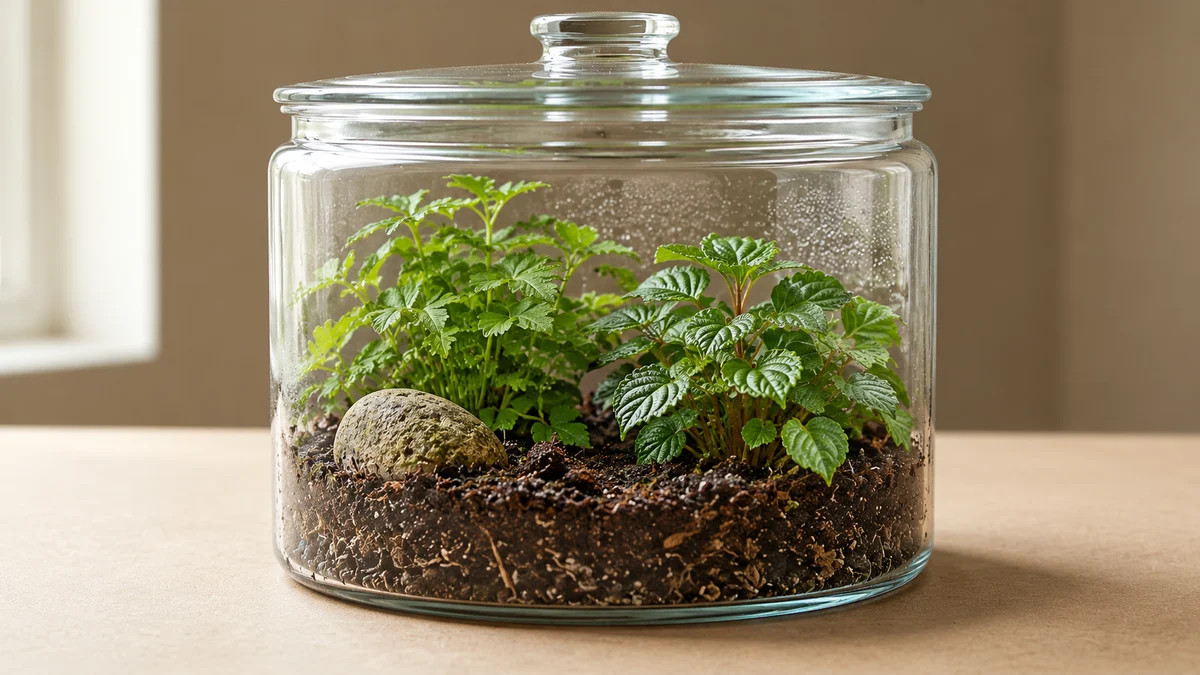
Look at the firm leaves, exposed medium and space above the growth. Confirm actual root moisture; this appearance alone does not establish long-term stability. - Keep observing without adding inputs
- Check
- Leaves remain firm, roots have appropriately moist medium, and growth has usable space.
- Action
- Leave the arrangement in suitable indirect light and compare conditions over time.
- Stop or reassess
- Reassess if moisture, growth or plant condition changes. Clear glass alone is not a reason to water.
- Heavy condensation persists
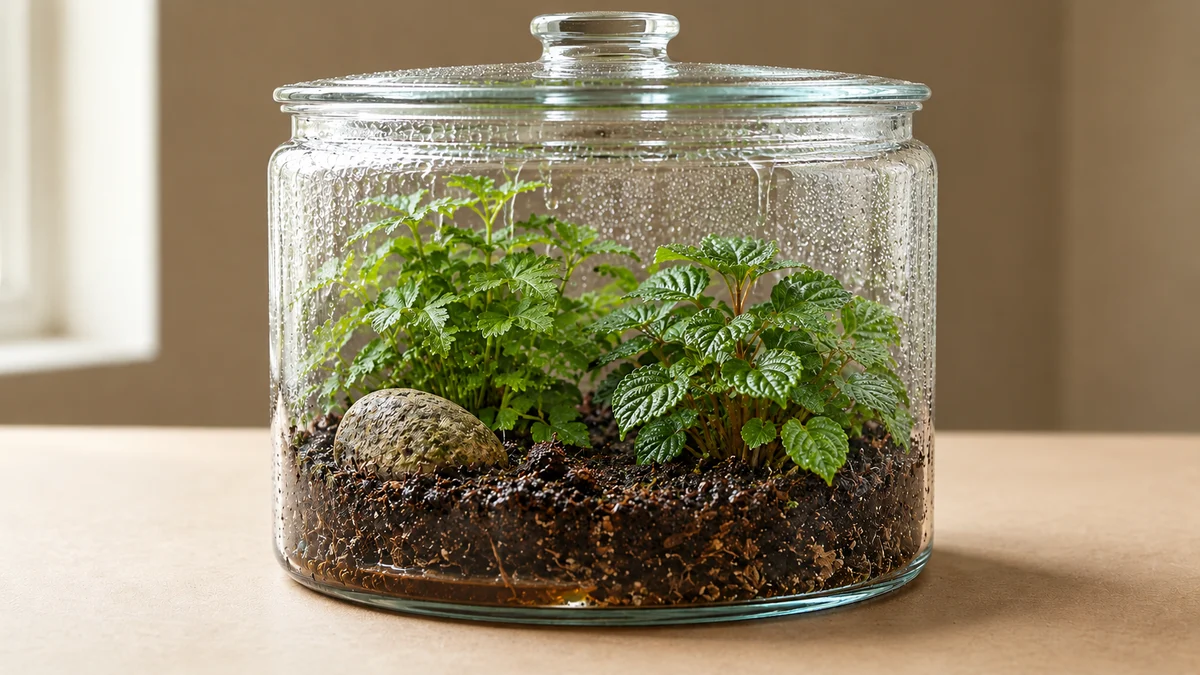
Check separately: droplets on the wall, the rooted medium, and water collected at the front base. The roots still need inspection; droplets alone do not diagnose rot. - Check the planting and let excess moisture escape
- Check
- Look for saturated medium, collected water and continually wet growth as well as droplets.
- Action
- Pause watering and open the lid while excess moisture escapes; reassess before closing.
- Stop or reassess
- If roots stay saturated or plants continue declining, change the root arrangement or planting rather than repeat an opening timer.
- There is little condensation
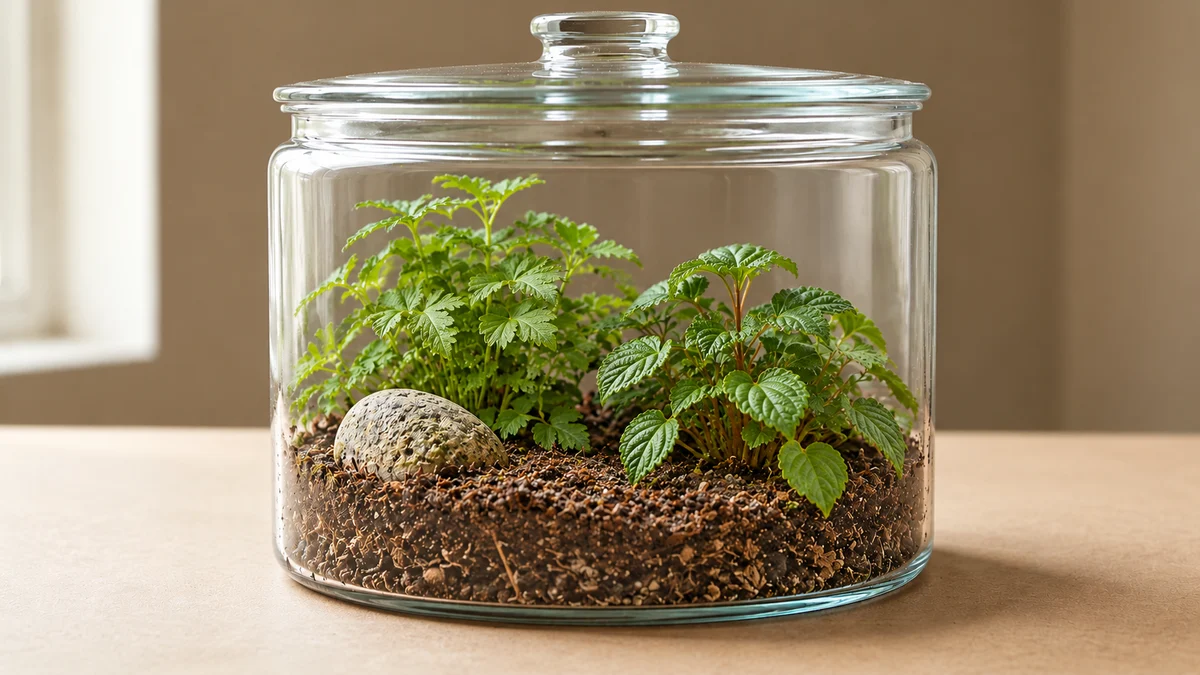
Clear walls and lowered leaves are cues to inspect the rooted medium. Neither proves drought; confirm moisture before adding water. - Check root moisture before watering
- Check
- Inspect the accessible rooted medium and plants; do not judge only the wall.
- Action
- If the medium is becoming too dry for those plants, add a small amount of water and recheck. If still moist, wait.
- Stop or reassess
- Wilt with wet roots calls for investigation, not another refill.
Evidence[3]
- Dead material or crowding is increasing
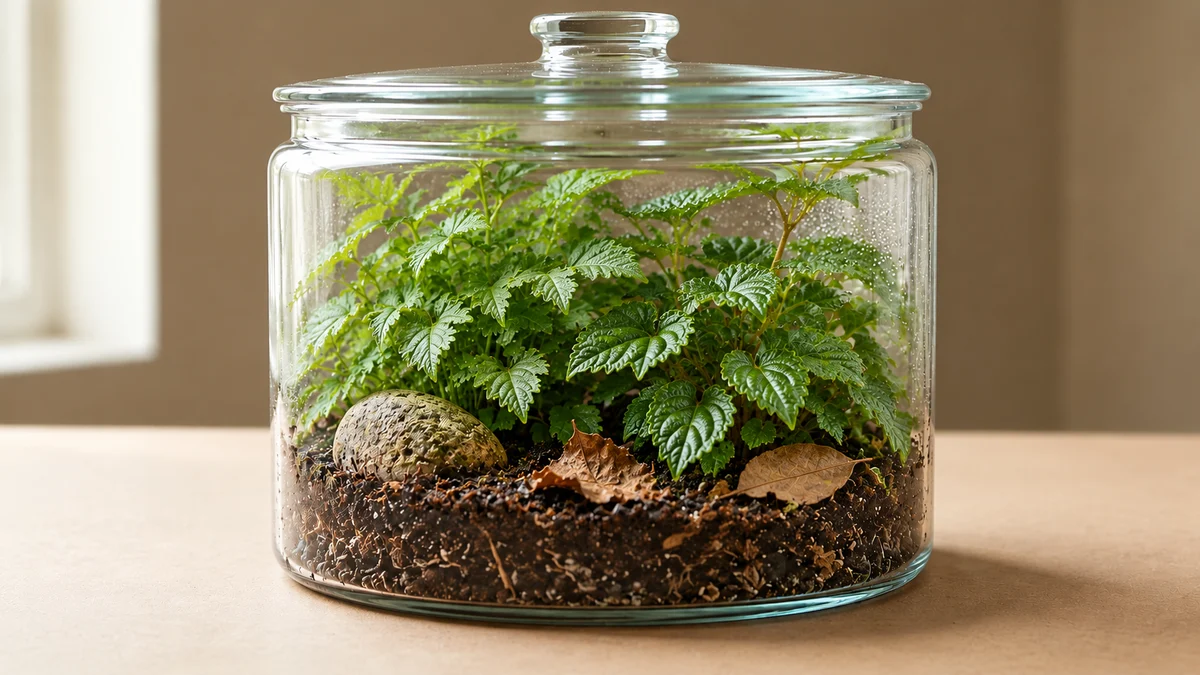
Look for overlapping growth, stems nearing the lid and the two fallen leaves within reach at the front. Remove dead material and assess growing space. - Open the garden for maintenance
- Check
- Find fallen leaves, decaying tissue and growth shading or pressing into its neighbors.
- Action
- Remove dead material; trim suitable plants or remove an outgrown one. Restore access to the remaining planting.
- Stop or reassess
- Recurring decline or unmanageable growth calls for a different plant or container.
Scope and important limits
A useful fit when
- Understanding recycling in a humid plant terrarium.
- Deciding whether to keep observing, adjust conditions or change the planting.
Use another path when
- Animal husbandry or aquatic ecosystem stocking.
- A survival duration, airtight-sealing recipe or guaranteed gas balance.
Horticultural guidance is combined with plant and soil biology. Applications to the jar are explained below; no Terrarium Guide growing trial is claimed.
What recycles, and what crosses the glass?
Follow the material or energy, then check the limit. These processes happen together; none is a complete health test.
| Flow | What happens inside | What the lid cannot guarantee |
|---|---|---|
| Water | Moist surfaces and leaves release vapor; it can condense and return to the medium. | Water reaches every root in the right amount. Openings allow water loss. |
| Carbon and oxygen | Photosynthesis takes up carbon dioxide and releases oxygen; respiration uses oxygen and returns carbon dioxide. | A fixed balance between organisms, light and gas use. |
| Mineral nutrients | Soil organisms break down organic residues, returning some nutrients to biological circulation. | Unlimited or immediately available nutrition for every plant. |
| Energy | Light enters and is captured in sugars; living processes ultimately release energy as heat. | An internal energy supply that can replace suitable light. |
How do plants get energy and exchange gases?
The garden needs a continuing light input
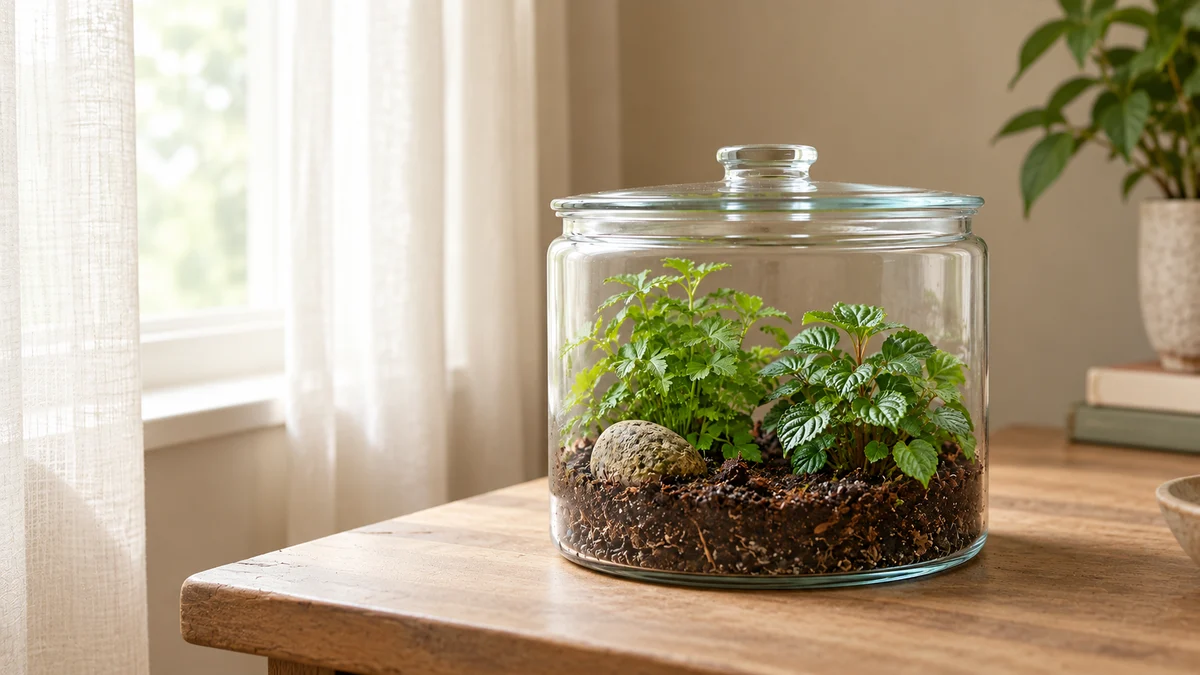
Plants capture light energy in sugars through photosynthesis. That energy supports growth and the organisms using plant material. Energy ultimately leaves as heat rather than cycling back into usable light.
For a humid foliage jar, provide suitable indirect light and avoid direct sun that overheats the enclosure. Moving it into darkness to suppress growth removes the input that supports the system.
Respiration continues during the day and night
Photosynthesis needs light, carbon dioxide and water. Respiration releases usable energy from sugars, consuming oxygen and producing carbon dioxide and water. Plants respire in daylight too; they do not simply switch from one process to the other at sunset.
Recycling gases is possible, but these processes do not establish equal rates in your jar. A sealed lid supplies no measurement of gas balance. Opening for necessary maintenance is compatible with caring for the garden.
Oxygen above the soil does not settle conditions below it
Roots obtain oxygen through their growing medium. Air and water occupy pore space; the medium’s physical structure affects their availability. Moisture retained by the lid does not remove this root requirement.
Apply that distinction by checking the rooted layer, not just humid air above it. A collection layer beneath a saturated bed does not carry water out through sealed glass.
Does decomposition supply everything the plants need?
Fungi, bacteria and other soil organisms break down organic matter in stages. Carbon and mineral nutrients move between residues, organisms and the growing medium. Recycling changes their form and availability; it does not manufacture a new supply of mineral elements.
Applied to a jar, this means visible decay is not proof of complete nutrition or a reason to keep every dead leaf. Follow terrarium hygiene guidance and remove dead material rather than letting it accumulate around living growth.
Do not use fertilizer as a balance adjustment
Iowa State advises avoiding routine fertilizer because it encourages growth and earlier crowding; some potting mixes already contain nutrients. Its conditional feeding advice concerns suspected low fertility, not every yellow leaf.
Check moisture, light and the named plant’s care before deciding on feeding. Fertilizer cannot replace light or restore suitable root conditions. A plant that needs a different feeding regime may require a more accessible arrangement.
Do springtails make the jar self-sustaining?
Springtails primarily feed on fungi, algae, pollen and decaying organic matter, according to University of Maryland Extension. That feeding role does not establish a maintenance-free terrarium or a guaranteed cure for visible mold.
Adding organisms does not supply light, create a water outlet or manage plant size. Keep those checks in place. This plant guide does not prescribe animal stocking or husbandry.
Track changes without chasing a perfect fog pattern
Make a simple record for your own garden. Observations of one container describe that container, rather than proving universal compatibility.
How long can it last, and should you seal it forever?
- Choose the opening and care arrangement Compare moisture retention, root needs, access and the work involved.
Your next step
- Decide how to add water when it is neededCheck the root zone, control the addition, and reassess without chasing fog.
- Use the ongoing maintenance routineTurn system observations into moisture checks, cleanup, trimming, and replacement.
- Build an accessible gardenPrepare roots, materials and a route for later maintenance.
Continue your terrarium plan
More detail when you need it
- Check visible mold and recurring growthDistinguish surface debris from damaged living tissue, remove affected material, and know when to inspect the plant.
- Provide and adjust the light inputCompare daylight and growing fixtures, then check coverage and daily timing.
- Understand the lower water routeA collection layer cannot guarantee aerated roots or remove water through glass.
- Choose plants for retained humidityCompare growth, conditions and common mismatches.
- Plan for growth in limited spaceCompare spread, headroom and removal access.
Explore more in build
Sources and review
- Terrariums and bottle gardens · Royal Horticultural Society
- How to Create and Care for a Terrarium · Iowa State University Extension and Outreach
- Plants and Youth: Designing and Building a Terrarium · University of Florida IFAS Extension
- Plant growth and development · Oregon State University Extension Service
- Nutrient Cycling · University of Illinois — Soil Quality for Environmental Health
- Soil Basics · University of Illinois Extension
- The Ecosystem and How It Relates To Sustainability · University of Michigan — Introduction to Global Change
- Springtails · University of Maryland Extension