Buying / Plants and delivery
Where to buy terrarium plants: local shops and online sources
Find a useful seller, confirm what will arrive, and inspect the plants before they enter your display.
By Terrarium GuideSources & editorial method
The short answer
Start with a local nursery or garden center when you want to inspect the actual plant and carry it home. For a particular small species, growth form, or specialist plant, compare a seller with a named catalog and a clear live-plant shipping policy. Regional online starting points for the United States, United Kingdom, Canada, and Australia are below.
Before paying, confirm the botanical identity, whether the plant is rooted, its actual dimensions, the shipping destination, and the arrival-claim procedure. A “terrarium plant” category, tiny pot, or mixed pack does not establish long-term size or compatible care. Plan a separate observation space before adding new plants to an existing collection.
Online places to start, by country
Use these catalogs to look for an already identified plant. They are examples with relevant listings and accessible policies, rather than a complete directory or an order-tested ranking. Check the current item, destination, weather arrangements, and total delivered cost before ordering.
United States: Glass Box Tropicals
The catalog separates ferns, orchids, moss, epiphytes, vines, and other plant types, which helps when you know the identity or growing form you need. Its shipping policy says it does not ship internationally. Read the current live-plant and claim terms; a store category is not a care guarantee.
United Kingdom: GrowTropicals
Its terrarium collection offers named plants and pot-size choices. Cross-check the actual plant against your growing space rather than assuming everything in that collection stays miniature. Delivery FAQs on the homepage describe UK services and possible weather delays; confirm the service for your postcode before paying.
Canada: Tails and Scales
Its live terrarium-plant collection is a starting point for named specimens, with separate plant categories elsewhere in the store. Use the plant shipping policy rather than dry-goods delivery offers: photographs can be representative, plant size can limit shipping, and receiving and weather arrangements matter. Ask for the actual specimen size when it is unclear.
Australia: Flower & Twig Nursery
Its separate plant-and-moss catalog is useful when you need planting material rather than a complete kit. Its FAQ currently lists live-plant delivery to Victoria, New South Wales, Queensland, South Australia, and the ACT, excluding Western Australia, Tasmania, and the Northern Territory. That is this seller’s service boundary; check another local supplier if your destination is excluded.
Scope and important limits
A useful fit when
- Buying identified plants for humid terrariums, open dry displays, and removable supports.
- Comparing local inspection with online availability and shipping work.
Use another path when
- A lowest-price tracker, a live inventory, or a tested ranking of sellers.
- Selecting a complete kit or treating a seller category as a planting plan.
Seller examples use published catalogs and delivery information checked on October 19, 2026. The links have no affiliate tracking. Plant suitability is assessed separately in the plant guides.
Choose the channel for the information you need
| Channel | Useful when | Check or ask before buying |
|---|---|---|
| Local nursery, garden center, or plant shop | You want to inspect a specimen and avoid parcel transit. | Bring the botanical name and opening dimensions. Ask permission before slipping a rootball out of its pot. |
| Domestic terrarium or tropical-plant specialist | You need named small plants or a particular growing form. | Actual size, rooted status, propagation conditions, shipping preparation, and whether the picture shows your specimen. |
| A specialist in orchids, carnivorous plants, succulents, or air plants | Identity and the particular group’s care are central to the purchase. | The exact species or cultivar, its growing history, and what support, roots, or seasonal routine come with it. |
| A named propagator, plant society sale, or marketplace seller | You are comfortable checking small starts or cuttings. | Who grew it, where it dispatches from, what is rooted, and how a wrong or damaged item is handled. Marketplace branding does not answer those questions. |
| Assorted or mystery plant pack | You can accept a variable selection and manage plants separately if needed. | Names, count, sizes, possible substitutions, and arrival forms. Skip it for a fixed small layout when the contents cannot be confirmed. |
- Choose the growing requirements first Use recorded plant facts and real guides before shopping by appearance.
Ask for a traceable cultivated origin
Evidence[1]
Get a usable description of the plant
Save the listing and written answers with your order. If an essential detail stays unclear, choose another specimen or seller.
- Test the actual entry and care route Include roots, pots, mounts, and a usable grip.
- Separate small sales size from long-term space Compare spread, height, and maintenance access.
Compare what arrives, not just the price per plant
| Listing form | What to establish | Work to plan for |
|---|---|---|
| Potted, rooted plant | Roots are established; the offered specimen and pot size are clear. | Inspect and observe separately, then check the rootball against the display. The shipping pot is not always the final planting container. |
| Rooted plug, division, or bare-root plant | What roots and growing medium remain, and whether the plant is acclimated. | Prepare appropriate root support and prompt plant-specific care; ask how to avoid drying or handling damage. |
| Unrooted cutting | Number of pieces, stem or node details, and the propagation method for that identified plant. | A separate propagation stage. It is not interchangeable with an established plant for a build you intend to finish immediately. |
| Tissue-culture or recently deflasked plantlet | Whether it is still sealed, semi-acclimated, or established in ordinary growing conditions. | Follow the supplier’s exact acclimation instructions. Confirm who completes that stage instead of treating every culture listing as ready to plant. |
| Live moss, air plant, or mounted plant | Living status, identity, and whether the surface, mount, or support is included. | Use the relevant planting and care method; absence of an ordinary soil pot does not by itself establish the correct method. |
- Check moss identity and living status Living cultures, dried fibers, and preserved decorations are different purchases.
- Check air-plant identity and support Keep the actual watering and drying route with the purchase.
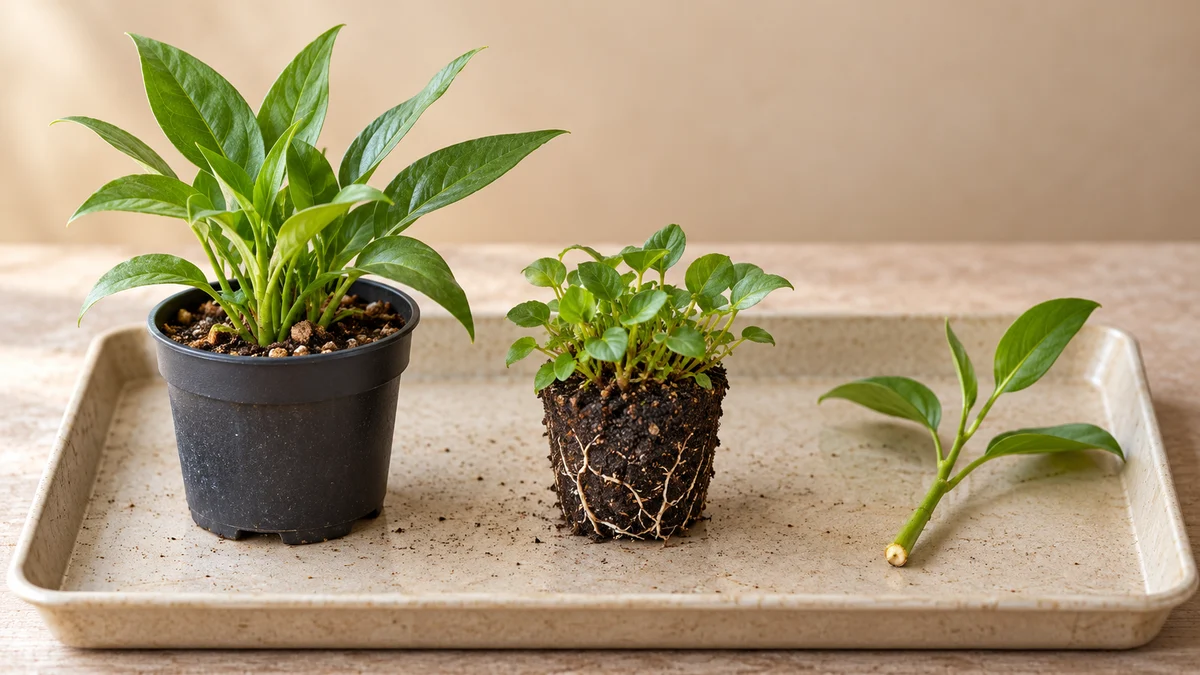
Look for the roots and growing medium in the specification
These three separate examples make the arrival-form distinction visible. Ask the seller for the specification and condition of the actual item.
Inspect the specimen before it joins other plants
In a shop, examine it before paying. For a parcel, inspect during unpacking and keep evidence needed under the seller’s claim procedure.
Look over leaves, stems, and the container
Inspect both leaf surfaces, stem joints, the medium surface, pot rim, and base. Look for insects, webbing, sticky deposits, eggs, and damaged growth; use a magnifier when needed. A quick clean-looking view is not proof that pests are absent.
Evidence[3]
Check roots when this can be done without damage
Ask the shop before gently removing a rootball. For a received plant, inspect only as its form and condition allow. Wilting in wet medium is a reason to investigate or decline a specimen, not automatically add water. Do not infer root health from color alone.
Evidence[2]
Observe separately with suitable care
Minnesota Extension advises isolating newly acquired houseplants for one to two weeks so problems can become visible. Use this as a general observation period, continue checking, and keep a suspect plant separate for investigation. Provide its appropriate light, temperature, and root care; a dark closed shipping bag is not an observation setup.
- Prepare the growing position Set suitable light before the new plant arrives.
Check the live-plant terms before checkout
Compare the whole transaction. A cheap cutting and an established pot may leave very different preparation and delivery work.
For cross-border orders, check the destination before paying
An online listing or a seller accepting an address does not establish that a plant may enter that destination. Identify the plant, arrival form, dispatch country, and destination, then check the current official requirements before ordering. Domestic movement and a seller’s service boundaries are separate checks too.
Use the relevant authority below. The Great Britain guidance covers England, Scotland, and Wales and links to separate Northern Ireland rules. Australian import guidance concerns entry from overseas; it does not replace state and territory movement checks. If you cannot establish the requirements for your order, choose a suitable domestic source or obtain advice from the destination authority first.
Match the purchase to the growing method
Keep the identified plant’s light, roots, mature growth, and care route with your order notes. A humid foliage plant, a drying succulent, an exposed air plant, and a carnivore do not become one compatible pack because a seller places them under the same display label.
Buy live moss as identified growing material when that is the intended job. Do not substitute preserved decoration or dried substrate fibers. For a plant sold on a mount, check the support and removal route; for a specialist root system, confirm the medium before choosing an add-on kit.
- Compare plants for retained humidity Check growth, management, and the conditions of the actual candidate.
- Choose a drying succulent display Keep light, a real water outlet, and drying conditions together.
- Check the identified carnivore’s needs Water quality, root medium, light, and seasonal care affect what to buy.
- Check orchid roots and support Choose between terrestrial pots, epiphytic pots, and mounts by identity.
Your next step
Prepare for planting
More detail when you need it
Explore more in buying
Sources and review
- How you can avoid buying trafficked plants — traceable cultivated origin · Royal Botanic Gardens, Kew
- How to grow houseplants — buying and specimen checks · Royal Horticultural Society
- Managing insects on indoor plants — inspection and new-plant isolation · University of Minnesota Extension
- Terrariums and bottle gardens — growing space and planting · Royal Horticultural Society
- Browse Glass Box Tropicals plant types · Glass Box TropicalsAccessed
- Read Glass Box Tropicals shipping and returns · Glass Box TropicalsAccessed
- Browse GrowTropicals terrarium plants · GrowTropicalsAccessed
- Read GrowTropicals delivery FAQs on its homepage · GrowTropicalsAccessed
- Browse Tails and Scales live terrarium plants · Tails and ScalesAccessed
- Read Tails and Scales plant shipping policy · Tails and ScalesAccessed
- Live Arrival Guarantee — plant service exclusions · Tails and ScalesAccessed
- Browse Flower & Twig plants and moss · Flower & Twig NurseryAccessed
- Read Flower & Twig delivery and plant FAQs · Flower & Twig NurseryAccessed
- United States: APHIS guidance for buying plants online · USDA Animal and Plant Health Inspection Service
- Great Britain: bringing plants and wood, including postal orders · GOV.UK
- Canada: CFIA guidance for online plant purchases · Canadian Food Inspection Agency
- Australia: DAFF live-plant import guidance · Department of Agriculture, Fisheries and Forestry