Plants / Orchid choices
Orchid terrariums: choose the roots, temperature, and growing room
Compare jewel orchids, mounted miniatures, cool-growing orchids, and small shop plants before choosing the glass.
By Terrarium GuideSources & editorial method
The short answer
For a foliage terrarium, compare Ludisia discolor in a reachable terrestrial pot. For a tiny mounted flowering accent in a managed warm enclosure, compare an identified Schoenorchis fragrans on removable cork with a thin moisture pad and roots that can dry after watering. These are two usable starting choices with different roots, light and care access; neither is a universal orchid routine.
Use an openable display. Check the whole plant at flowering, its spreading or climbing growth, and whether the pot or mount can come out for care. A mini Phalaenopsis can be a removable flowering display; a cool-growing Lepanthes or Masdevallia needs its own temperature plan. A small nursery pot does not establish a plant for a permanently sealed bottle.
Choose the root-care route first
A terrestrial pot, an airy orchid pot and a removable mount create different care tasks. Start with the route you can maintain, then compare the named plants and temperature requirements below.
- Terrestrial jewel orchid
- Use a suitable terrestrial medium with reachable drainage and spreading room.
- Check
- Ludisia uses a terrestrial root mix; Macodes has its own lightly damp culture guidance. Neither uses the exposed-root arrangement shown in the mounted example.
- Action
- Keep Ludisia in a shallow draining pot with spreading room and an inspection edge. Follow its full planting guide for the chosen mix and watering routine.
- Stop or reassess
- Shared humid air does not make Ludisia and Macodes interchangeable. RHS and NC State describe different pot-moisture contexts for Ludisia; retain the instructions for your actual setup.
- Epiphytic orchid in a pot
- Keep the airy root system and drainage outlet functional.
- Check
- For Phalaenopsis, inspect the bark-based medium, roots, and pot outlet. Avoid water retained in the crown or outer glass.
- Action
- Take the pot out to water, let excess water drain, and empty the outer container before returning it. Keep the crown and roots accessible.
- Stop or reassess
- Do not bury its orchid pot under a wet terrestrial bed or cover the outlet with decorative moss.
Evidence[10]
- Mounted miniature · S. fragrans example
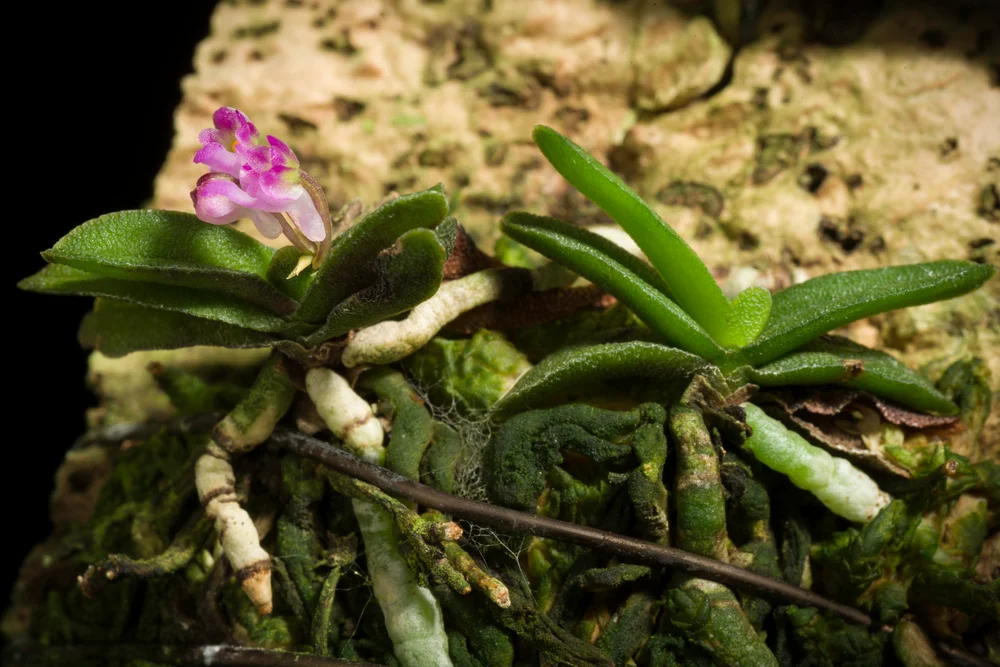
Look for pale roots running over the support beneath the thick leaves. This S. fragrans close-up leaves the complete mount and hanger out of frame; test removability with your actual mount. Image: sunoochi · CC BY 2.0 - Make the support removable and keep the growing point uncovered.
- Check
- Inspect where the roots meet the support, then test the actual mount and hanger through the opening. AOS warns that tightly packed Sphagnum is difficult to wet and dry properly.
- Action
- For identified S. fragrans, use the warm-enclosure branch below: keep its cork accessible, moisture pad thin, and roots available for watering and drying checks.
- Stop or reassess
- Choose another arrangement if the mount cannot be removed for its care. The close-up shows root attachment; it does not establish a working hanger or the required climate.
- Compare the materials behind the root method Keep terrestrial pots, airy orchid roots and removable mounts distinct.
- Plant Ludisia in its terrestrial pot Choose material, handle the rootball and judge moisture in the actual display.
- Follow the mounted S. fragrans branch Keep cork, thin root pad, warmth and drying in the same routine.
Scope and important limits
A useful fit when
- Choosing a named orchid and a root arrangement you can inspect and maintain.
- Comparing foliage, flowers, mounted growth, temperature control, and usable space.
Use another path when
- A universal orchid mixture, watering calendar, or sealed-bottle recommendation.
- Treating all jewel orchids, all miniature labels, or all members of a genus as interchangeable.
These are source-based selection comparisons and editorial applications to glass displays. General genus culture is identified as such; it does not establish a new species record, a tested planting, or compatibility with neighboring plants.
Which orchid matches the care you can provide?
Ludisia and S. fragrans below are concrete starting choices. Macodes, Lepanthes and Masdevallia explain other growing directions; those genus-level rows are not a finished shopping list or a shared planting.
| Named plant or source scope | Roots and growing conditions | Your selection decision |
|---|---|---|
| Ludisia discolor · terrestrial jewel orchid | NC State: warm humid air, intermediate light, moist well-drained terrestrial medium, and good air circulation. | Compare for foliage in a shallow wide pot. Allow creeping stems, upright shoots, and flowers; choose accessible lateral room rather than a narrow bottle. |
| Macodes · jewel-orchid genus, including plants sold as M. petola | AOS genus guidance: shallow pots of terrestrial mix, intermediate temperatures, medium to low light, and lightly damp medium without drought or drafts. | AOS explicitly describes terrarium culture. Verify the species and its conditions; this genus guidance does not supply a fixed mature size or prove permanent sealed performance. Evidence[6] |
| Schoenorchis fragrans · a mounted-species choice | A miniature flowering epiphyte for a warm managed enclosure. D.O.G.’s named-species account uses cork, very little Sphagnum and air movement so roots dry after watering; AOS also reports warm terrarium cultivation. | Choose when the whole mount can come out for watering, roots remain visible, and you can maintain warmth and drying together. Read the mounted routine below; the genus alone would not establish those species-specific choices. |
| Lepanthes · miniature epiphytic genus | AOS: small pots of fine epiphyte mix or a slab with a small moisture pad. Most species need cool-intermediate temperatures, medium light, high humidity, and constant root moisture. | Compare for a managed humid enclosure with a verified temperature range. Miniature leaves do not make a warm room or drying mount suitable. Evidence[8] |
| Masdevallia · source guidance for most species | AOS gives 55–72°F (about 13–22°C) as an ideal range for most species, with moist roots during active growth, humidity, and air circulation. Warmer- and colder-growing species differ. | Choose the identified species or hybrid for your measured day and night temperatures. A humid lid cannot cool a warm display or establish a compact flowering size. Evidence[9] |
| Mini Phalaenopsis · named species or hybrid if available | RHS: warm indoor conditions, bright filtered light, and loose airy bark-based medium; roots must drain and must not remain in water. | Compare as an accessible removable pot. Check leaf span and the whole arching flower stem. A small retail pot or the word mini does not settle the eventual display dimensions. Evidence[10] |
| Vanilla planifolia · climbing orchid | NParks describes a root-climbing vine, warm humid culture, partial sun, and well-drained roots. Its Singapore landscape profile reports growth up to 10–15 m. | A starter cutting belongs in a plan with substantial support and future growing space. Choose another orchid for a compact jar; the landscape measurement is a warning about growth, not a required bottle height. Evidence[11] |
Evidence[2][6][7][8][9][10][11][16][17]
- Choose the pot, bed, or removable mount Keep root care separate from humidity in the surrounding glass.
A removable cork accent: Schoenorchis fragrans
Use this branch for an identified nursery-propagated S. fragrans. The species-specific temperature and lighting examples are growers’ published conditions, not a tested optimum or a requirement to reproduce their equipment.
Choose a warm enclosure position with space around the mount
D.O.G.’s Thomas Jacob describes days from about 24°C in winter to over 30°C in summer, and winter-night lows around 15.5–16°C; AOS’s Jan Teitsworth reports better performance in a warmer terrarium than his intermediate greenhouse. Use a measured warm day/night plan and prevent heat building up under lights. Those observations are not universal safe lower or upper limits.
Start with the plant on a small removable cork mount
AOS describes slab culture for the genus. In Jacob’s S. fragrans setup, only a minimal Sphagnum pad lies between roots and cork. Keep an established healthy mount intact when possible; secure the mount to an accessible support rather than burying roots and crown in a wet bed. Reserve space beyond the current leaves for new growth and flowering sprays.
Water the root pad, then observe actual drying
Take the mount out where you can wet the roots evenly and let excess drain; return it without leaving the crown sitting in water. Use only a thin pad, leave roots visible, and check whether they dry after watering. If the pad remains soaked, reduce retained water and improve air movement or change the mounting arrangement. Do not copy the account’s automated misting frequency to a different enclosure.
Set light and neighbors without hiding the root checks
AOS’s genus guide describes bright light, whereas Teitsworth reports lower-light S. fragrans culture; Jacob describes a much brighter artificial-light setup. Start with filtered light suited to the established plant and adjust gradually while checking heat and new growth. Do not combine these reports into a universal lux target. Keep taller foliage off the small mount and retain the route for watering and inspecting it.
A jewel orchid needs more than leaf clearance
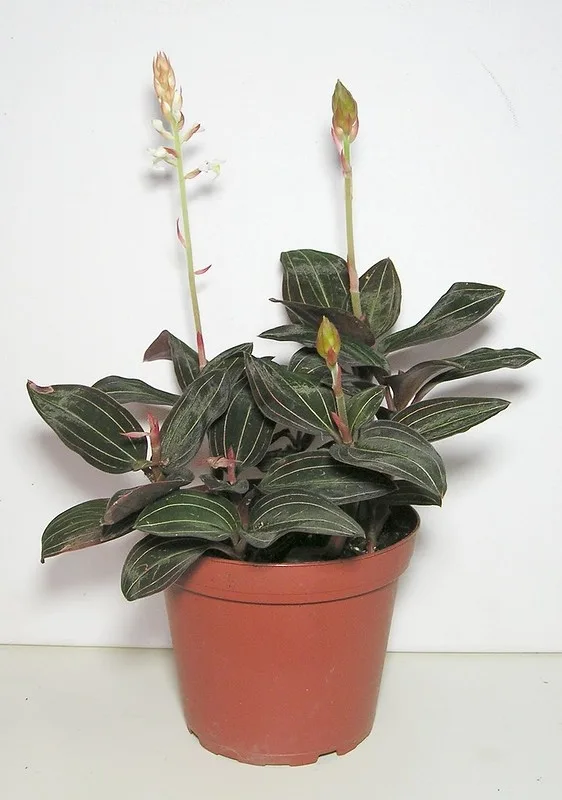
Ludisia’s creeping stems and upright growth use different parts of a display. This existing photograph shows the named plant’s habit; it does not stand in for another jewel-orchid genus.
Plant records
Identity record
Ludisia discolor
Leave room along the pot edge for new stems and above the foliage for flowering.
Small starter leaves do not establish the space needed by an expanding plant.
Read the plant profile- Check Ludisia in a partly open display with its own pot Keep the existing root-zone, space, and management conditions with that scenario.
- Choose Ludisia’s medium and planting method Use the full terrestrial planting guidance for this species.
Choose the enclosure by what it can maintain
| Display | Useful when | Check before choosing |
|---|---|---|
| Open bowl or glass surround | A removable orchid pot can be watered and drained easily. | Room humidity, light, and temperature still have to suit the plant. An open vessel does not create a cloud-forest environment. |
| Openable humid terrarium | You can inspect roots and growth, manage retained moisture, and remove the plant. | Check temperature at plant height, air movement among leaves, and actual root moisture. Condensation alone cannot settle watering. |
| Managed orchid enclosure | The chosen orchid needs controlled temperature, humidity, and air movement beyond the room conditions. | Confirm the named plant’s range, summer heat, night temperature, and access for maintenance. A fan moves air; it does not by itself provide cooling. |
| Narrow or permanently sealed bottle | Consider a different container when the pot, mount, or future flowering growth cannot be reached. | Neither a miniature label nor a general terrarium-use statement establishes successful permanent sealing. Plan inspection and removal before planting. |
Take these checks to the orchid seller
The root routes above and the mounted steps explain placement and watering. Resolve these purchasing details before building around a small plant.
- Check propagated origin and delivery details Keep orchid identity, root method and growing conditions here; use the general seller and shipping checks.
- Test the opening and growing room Use the finished space and actual plant instead of the vessel’s outside dimensions.
Other jewel orchids and miniature labels need their own identity
Macodes and Ludisia are distinct genera. Other plants sold as jewel orchids, including Anoectochilus and their named hybrids, need their own care and growth information; an attractive veined leaf does not transfer Ludisia’s potting instructions or a shared planting plan.
For an unidentified mini orchid, ask which species or hybrid the label describes and whether mini refers to flowers, current pot size, or the plant at flowering. If the seller cannot supply the conditions and growing room needed for your display, choose an identified alternative from the comparison rather than designing around an unknown adult plant.
Your next step
Use your plant shortlist
More detail when you need it
- Ludisia discolor: planting and carePlant and care for Ludisia discolor in a ventilated humid display. Choose a shallow root zone, manage creeping stems, remove spent spikes, and check decline.
- Compare a partly open humid displayRead the existing Ludisia scenario alongside other independently watered plants.
- Check an openable closed plantingKeep the named plant’s conditions and reachable maintenance with the enclosure choice.
- Look up recorded names and conditionsA name match or listed plant does not create a new mixed-planting verdict.
Explore more in plants
Sources and review
- WFO Plant List — pinned 2026-06 classification · World Flora Online
- Ludisia discolor — terrestrial roots and growing room · NC State Extension
- Ludisia — growth and terrestrial pot culture · American Orchid Society
- Ludisia discolor — source-scoped growth profile · NParks Flora & Fauna Web
- Ludisia discolor — pot culture and spent flower stems · Royal Horticultural Society
- Macodes — genus culture and terrarium use · American Orchid Society
- Schoenorchis — mounts and seasonal exceptions · American Orchid Society
- Lepanthes — miniature epiphytes and cloud-forest culture · American Orchid Society
- Masdevallia Culture Sheet — temperature, water, and air · American Orchid Society
- How to grow Phalaenopsis — roots, flowers, and pot care · Royal Horticultural Society
- Vanilla planifolia — climbing growth in a Singapore landscape profile · NParks Flora & Fauna Web
- Mounting orchids — supports and root moisture pads · American Orchid Society
- Air Movement — humidity and root water are different · American Orchid Society
- Indoor orchids — choices and growing methods · Royal Horticultural Society
- How to Create and Care for a Terrarium · Iowa State University Extension and Outreach
- Schoenorchis fragrans — Thomas Jacob’s mounted-enclosure cultivation account · Deutsche Orchideen-Gesellschaft
- Keeping Track of a Multi-Genus Collection — Jan Teitsworth’s S. fragrans terrarium observation · American Orchid Society