Plants / Open succulent displays
Succulent terrarium plants: choose light, drainage, and growing room
Compare compact rosettes, broad Aloe leaves, woody jade, and trailing stems before choosing an open display.
By Terrarium GuideSources & editorial method
The short answer
Use an open display with a draining root zone for these drying succulents. Compare Haworthiopsis attenuata for bright indirect light, an identified Echeveria for a sunny rosette, Aloe vera for a broader offsetting rosette, and jade for a woody focal plant. Burro’s tail needs a free trailing edge rather than a tight bottle neck. Choose by the conditions and growth you can maintain, not by a mixed “mini succulent” label.
For ordinary glass without drainage holes, use reachable pots with outlets, remove them to water and drain, and empty water from the outer vessel. A stone layer does not give trapped water a way out. Keep moist groundcovers out of the shared drying bed; neither an open top nor fleshy leaves establishes compatible care.
Choose the growing form and light you can provide
| Plant or group | Light and growth to plan for | Useful choice or reason to reconsider |
|---|---|---|
| Zebra haworthia · Haworthiopsis attenuata | Prefers bright indirect light. Compact star-shaped rosettes produce offsets; NC State reports 4–12 in. height and 6 in.–2 ft. width. | Compare for a bright indirect position, with draining mix and drying between waterings. Allow for the clump; low-light tolerance is not a preference for a dark shelf. |
| Echeveria · verify species or cultivar | NC State’s genus guidance favors a sunny window, little water, and very well-drained soil. Rosettes can produce offsets, expose stems as they age, and send up flower stalks. | Compare for a sunny, accessible rosette display. Identify the form before assigning dimensions; a genus-level description cannot guarantee the size of a hybrid or establish a shared watering plan. |
| Aloe vera | Sun to partial shade; complete drying between waterings. Broad leaves, offsets, and an eventual flowering stem use more space than a starter pot suggests. | Choose for a larger, reachable rosette position. Reserve lateral room and removal access; compare the individual conditions below before considering the jade pair. |
| Jade · Crassula ovata | Bright indoor light, with sun and afternoon shade in NC State’s advice. Woody branches form an enlarging canopy; water when soil is dry. | Choose when you want a shrub-like focal plant and can manage its canopy. A small nursery plant is not a permanently miniature tree. |
| Burro’s tail · Sedum morganianum | High interior light with at least partial sun, fresh air, draining soil, and drying between waterings. Stems can trail to 24 in.; leaves detach easily when handled. | Use a reachable open rim or hanging position with trailing clearance. Reconsider a narrow neck that forces stems against the glass or makes removal damage likely. |
| Hens and chicks · Sempervivum tectorum | Full sun, sharp drainage, and colonies formed by offsets. Each flowering rosette dies after blooming. | Compare for a sunny container or rock-garden direction with room for offsets and replacement of spent rosettes. Its outdoor care context does not prove suitability for a warm indoor glass display. |
Evidence[19][20][3][4][21][22]
- Choose a real drainage route Decide between shared draining soil and separately watered pots before buying.
Scope and important limits
A useful fit when
- Choosing plants and root-zone management for an open succulent display.
- Comparing an Aloe–jade layout with other sourced growth and light choices.
Use another path when
- A sealed, continually moist succulent jar.
- A universal cactus routine or a complete terrarium construction tutorial.
The wider comparison applies published horticultural care to your choice. The detailed Aloe–jade plan below applies to its stated light, drainage and growing space; do not add the other choices without checking their complete care. Published dimensions are context, not predictions of growth inside glass.
Choose light first, then where the growth can go
A compact clump, a sunny rosette and a trailing plant use different positions. These are alternative choices, not members of one suggested mixture.
- Bright indirect light and a clumping rosette
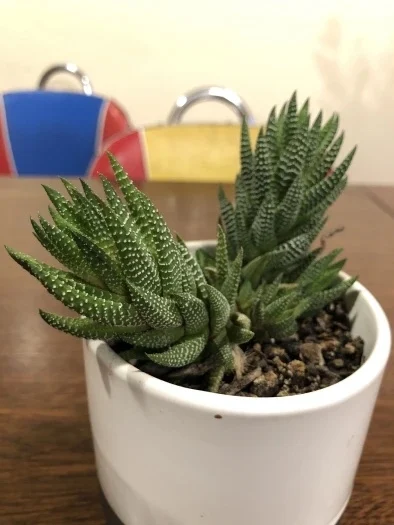
Source-labeled Haworthiopsis attenuata shows banded pointed foliage and more than one upright clump. Check your plant’s identity and room for offsets; the pot does not show a drainage route. Image: Guillaume Clin · CC BY 4.0 - Consider an identified Haworthiopsis attenuata
- Check
- Check the banded plant’s botanical label, space for offsets and a root zone that can drain and dry.
- Action
- Use freely draining succulent medium; allow it to dry between waterings. In solid glass, lift the draining pot out to water and empty its saucer before return.
- Stop or reassess
- Do not put it on a dark shelf or into a continually moist woodland bed. The label zebra plant alone leaves the identity unresolved.
- A sunny position and a radial rosette
- Identify the Echeveria before planning its footprint
The genus-level source supports a sunny window, very well-drained soil and restrained watering; different species and hybrids need their own size check.
- Action
- Choose the named plant, leave offset and flower-stem room, and keep a usable drainage and removal route.
- Stop or reassess
- An unnamed mini rosette cannot inherit another plant’s mature size or the Aloe–jade combination conditions.
- An open edge with room below it
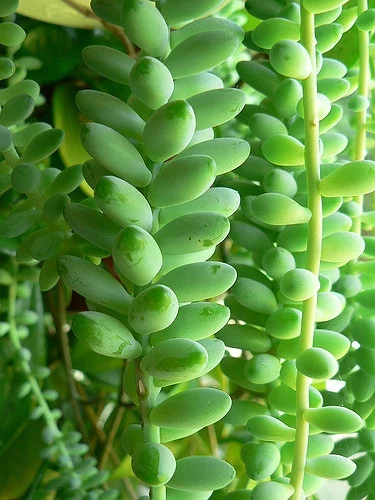
The hanging stems explain the space this plant uses below its pot. This close view leaves the container out of frame; it does not establish a fit through a glass opening. Image: Hunda · CC BY-SA 2.0 - Compare Sedum morganianum trailing growth
- Check
- Can the stems hang clear of glass, and can the container move without brushing or stripping the fragile leaves?
- Action
- Use a reachable open rim or hanging position with high indoor light and at least partial sun, draining medium and drying between waterings. Water the pot separately from an outer display.
- Stop or reassess
- Choose another shape when a narrow neck traps the stems. A short cutting does not remove the future trailing-space requirement.
Choose the root zone before the members
Opening the top improves exposure to room air; it does not let excess water leave the bottom. For the Aloe–jade plan, use a container with drainage holes. Treat unperforated glass as an outer display when using removable pots.
- Glass can hold removable draining potsChoose pots with drainage holes that you can lift through the opening without damaging the plants. Remove each pot to water, let it drain, and empty collected water from the outer glass before returning it. This is separately managed soil, not the shared-root Aloe–jade planting.
- Assign light to each canopyKeep the bright-indirect Haworthiopsis choice separate from the assumption that every succulent wants the strongest direct sun. A tall jade can shade a rosette. If each member cannot receive its stated light, reduce the planting or use separate displays.
- Leave a way to inspect and remove the plantCompare canopy, rootball, future offsets or branches, and any trailing or flowering route with usable space. Keep the soil reachable for moisture checks. If removal would trap leaves or break stems, choose a wider opening or another growing form.
Reconsider these tempting combinations
| Tempting choice | Why it changes the care plan | What to do instead |
|---|---|---|
| A succulent surrounded by baby’s tears or Fittonia | These humid foliage choices need moist roots; Aloe needs thorough drying. Watering a connected bed cannot independently satisfy both routines. | Choose a drying succulent display or a humid planting. Independently watered pots still share the same air and light. |
| A “cactus” added to the Aloe–jade bed | Thanksgiving cactus, Schlumbergera truncata, is an epiphytic rainforest cactus: the source describes moist drained mix, high humidity, and partial shade, unlike this drying sunny plan. | Verify the species and its care. Keep this cactus on its own stated routine; do not apply one desert-style rule to the whole cactus family. |
| Several unidentified mini succulents sold together | Similar pot sizes conceal different rosette, branching, trailing, and light needs. An Echeveria genus label or an unverified zebra-plant label leaves the identity check incomplete. | Ask for names and cultivated forms. Compare each member independently; omit a plant whose needs you cannot establish. |
| A drying pot next to a mounted air plant | A supported Tillandsia has a separate watering and drying task; shared display space does not make it a member of the succulent root zone. | Keep a reachable, separately watered support in suitable air and light, or use another display. |
Evidence[5][6][3][23][20][19][7]
- Choose a humid planting instead Compare moist-root foliage and independent-pot roles.
- Check Spanish moss support and drying Use the species-specific care zone rather than a shared soil bed.
If you choose Aloe or jade, keep these individual conditions
Use these complete light, drying, temperature and space checks for the broad Aloe rosette or woody jade canopy. They are one branch of the selection above, not the default answer for every open display.
Candidates for these conditions
Conditional fit
Aloe vera
A conditional candidate for a bright, open succulent display, provided the actual plant and the source-reported mature and flowering outline fit the allocated space. Horticultural dimensions guide planning; they do not predict growth inside glass.
Read the plant profileAloe vera in an open succulent display
An open, bright display with freely draining soil that dries between waterings. Check the actual light and day and night temperatures against each plant’s care guidance.
A rosette focal plant allocated space for its actual canopy and flower stalk.
- Planting zone
- Freely draining succulent substrate; allow thorough drying between waterings.
- Check at the plant position
- Light at the canopy; Day and night temperatures, checked against each plant profile; Actual specimen dimensions; Container footprint, depth, and growing space; Drainage
Required care and access
- Choose bright sun or a verified grow-light position.
- Use very freely draining substrate and wait for thorough root-zone drying before watering.
- Measure the actual plant and compare the source-reported mature and flowering height with available space. This is planning context, not a terrarium size prediction.
- Check actual day and night temperatures against Aloe vera’s own care guidance; compare jade separately before sharing the position.
Conditional fit
Crassula ovata
A conditional candidate for the bright, drying, ventilated display. Sources describe a potentially large woody shrub in ordinary cultivation; fit depends on the actual plant and allocated space, without predicting a fixed size inside glass.
Read the plant profileJade in an open succulent display
An open, bright display with freely draining soil that dries between waterings. Check the actual light and day and night temperatures against each plant’s care guidance.
An upright woody focal plant sized to the actual specimen and reserved canopy space.
- Planting zone
- Freely draining succulent substrate; allow drying between waterings.
- Check at the plant position
- Light at the canopy; Day and night temperatures, checked against each plant profile; Actual specimen dimensions; Container footprint, depth, and growing space; Drainage
Required care and access
- Provide bright light and open air.
- Use draining substrate, water after the soil dries, and reduce watering in fall and winter.
- Check the actual plant and reserved canopy space. Source-reported horticultural dimensions inform growth planning without predicting the same size inside glass.
- Check actual day and night temperatures against jade’s own care guidance; compare Aloe vera separately before sharing the position.
When Aloe and jade can share a draining bed
This is the complete Aloe–jade layout. Matching the drying direction is only the start: measure both plants and check the drainage outlet, light, day/night conditions, and access. It is an editorial application of sources, not a site growing trial. Choosing separate removable pots changes the shared-root layout and needs its own checks.
Use only with these conditions
Aloe vera and jade in an open succulent display
Aloe vera and jade can share an open, bright display when water has a real drainage outlet and the soil dries between waterings. Check both plants and growing space first; an open top or a stone layer does not drain a glass bowl.
Layout: An open succulent display with enough room for both actual plants, their canopies, and flowering stems.
- Aloe vera — Basal rosette focal pointShared soil that drains freely and dries between waterings
- Crassula ovata — Upright woody focal pointShared soil that drains freely and dries between waterings
Compare these plants in your actual display. Measure the container, plant size, light, airflow, and indoor conditions, and decide whether the layout is seasonal or intended for longer use.
- Shared planting zones
- Shared soil that drains freely and dries between waterings
- Roles in this layout
- Basal rosette focal point
- Upright woody focal point
Shared conditions
- Open air and bright sunlight; very freely draining shared soil that dries between waterings; ordinary indoor humidity. Check actual day and night temperatures against each plant’s guidance before sharing this position.
Required care and access
- Measure both plants, their canopies, and the route for flowering stems before assigning shared soil space.
- Water according to the soil’s actual drying, rather than a fixed calendar.
- Check the source temperature ranges for each plant. Leave room for canopies and flowering stems; pruning is not a default solution when tools cannot reach.
Conflicts to check
- Ordinary horticultural mature spreads can exceed some compact layouts. Use those source dimensions as planning context, not a prediction of size inside glass; compare the actual specimens with their assigned space.
Check in your actual display
- Light reaching the canopy
- Actual day and night temperatures
- Actual plant and rootball dimensions
- Container footprint and soil depth
- How water drains from the shared soil
Carry the choice into a workable care routine
For Aloe and jade, inspect the root zone and growth rather than copying a universal dose or weekly calendar. For other choices, retain the different care stated in the comparison.
Check the position and the actual plant
Give Aloe and jade the bright conditions in their profiles, while respecting jade’s afternoon-shade advice. Inspect whether a canopy shades its neighbor and whether leaves touch the removal opening. If the light or space cannot work for each, keep fewer members or separate displays.
Water only after the required drying
Let Aloe’s medium dry completely; water jade when its soil is dry. Check the root zone, not just the decorative surface. Water draining pots outside the glass, let excess leave, and return them after draining. Different rootballs need separate checks even when the general routine matches.
Adjust with season and placement
Reduce Aloe watering in winter and jade watering in cooler months as their sourced routines require. Compare actual day and night temperatures with each plant’s guidance; a shared location still has to meet each plant’s needs. Protect portable plants from the cold conditions cautioned against by their sources.
Move a member before growth closes the care route
Watch Aloe offsets and jade’s expanding branches. Recheck whether each canopy has its own light and whether you can reach soil and lift out the plant. Relocate an outgrown member into a suitable draining container when that space cannot be maintained; do not treat pruning as possible through an inaccessible neck.
Change the setup when the care cannot work
- Soil remains wet
- Check drainage before adding water.
- Check
- Inspect whether water can leave and whether an inner pot sits in collected water.
- Action
- Remove the pot from standing water and empty the outer display. Move a shared planting without an outlet to a draining container.
- Stop or reassess
- Do not add water to wet medium or more stones to compensate for a missing outlet.
- The available position has less light
- Choose the light requirement deliberately.
- Check
- Compare light at leaf level with the identified plant’s source guidance.
- Action
- Consider bright-indirect Haworthiopsis when that is what you can supply; provide a suitable sunny position for Echeveria. If neither condition is available, change the placement or choose another care direction.
- Stop or reassess
- Do not turn low-light tolerance into a claim that a dark shelf is suitable.
- The specimen is labeled only mini or cactus
- Resolve identity before mixing.
- Check
- Ask for the botanical name, cultivated form, mature growth, and watering guidance.
- Action
- Compare named plants against your actual root zone, light, and growing room. Buy an identifiable single specimen when a mixed tray cannot supply those facts.
- Stop or reassess
- Leave an unknown plant out of the shared bed rather than inheriting another species’ routine.
Your next step
Use your plant shortlist
More detail when you need it
- Design a rosette and stone displayKeep a single Haworthiopsis in a removable draining pot with a separate hardscape accent.
- Aloe vera: planting and careChoose an open Aloe vera display with real drainage. Plant the rosette, water after thorough drying, separate offsets, and check soft leaves or stretching.
- Jade plant: planting and carePlant and maintain Crassula ovata with bright light, drainage, and drying between waterings. Prune to a branch, root cuttings separately, and check decline.
- Compare different care plansChoose between a humid pair, competing groundcovers, and this drying succulent layout.
- Browse the recorded plant identitiesUse names and factual filters; matching tags do not prove compatibility.
Explore more in plants
Sources and review
- Aloe Vera · University of Arizona Cooperative Extension
- What is the problem with my indoor jade plant? · Missouri Botanical Garden
- Aloe vera — NC State Plant Toolbox · NC State Extension
- Crassula ovata — NC State Plant Toolbox · NC State Extension
- Fittonia albivenis — NC State Plant Toolbox · NC State Extension
- Soleirolia soleirolii — NC State Plant Toolbox · NC State Extension
- Tillandsia usneoides — NC State Plant Toolbox · NC State Extension
- Aloe, a Hardy Houseplant · Penn State Extension
- Indoor Plant Care — Purdue Extension HO-39 · Purdue University Extension
- Aloe | RHS Plant Guide · Royal Horticultural Society
- Care tips for light-loving houseplants at the RHS Urban Show — Aloe vera section · Royal Horticultural Society
- Aloe vera | Barbados aloe · Royal Horticultural Society
- Care tips for light-loving houseplants — Crassula ovata section · Royal Horticultural Society
- Crassula ovata | jade plant · Royal Horticultural Society
- Aloe, Barbados Aloe, Kitchen Aloe | Texas Tech Plant Database · Texas Tech University Plant Resources
- Aloe Vera — Gardening Solutions · University of Florida IFAS Extension
- Jade Plant, Crassula ovata · University of Wisconsin–Madison Division of Extension
- WFO Plant List 2026-06 · World Flora Online
- Haworthiopsis attenuata — NC State Plant Toolbox · NC State Extension
- Echeveria — NC State Plant Toolbox · NC State Extension
- Sedum morganianum — NC State Plant Toolbox · NC State Extension
- Sempervivum tectorum — NC State Plant Toolbox · NC State Extension
- Schlumbergera truncata — NC State Plant Toolbox · NC State Extension