Build / Choose the environment
Closed vs open terrariums: choose the conditions you can maintain
Compare moisture retention, air, roots, and access before choosing a lid or an open display.
By Terrarium GuideSources & editorial method
The short answer
Choose a closed terrarium with a removable lid for plants that benefit from humid air and a moist, drained root zone. Choose an open display when the plants need more exposure to room air, roots that dry between watering, or a removable air-plant support. A partly open humid planting is another option when you can monitor moisture loss and maintain the plants through the opening.
There is no universal easier choice. Closed gardens conserve water but still need inspection and growth control. Open displays offer access and greater exchange with room air, while their watering, light, and drainage still depend on the plants. Opening the top does not drain wet soil or make incompatible plants share one care routine.
What changes when you add or remove the lid?
Read each column as a care arrangement. “Open” covers several kinds of planting, rather than one universal dry environment.
| Decision | Closed · removable lid | Partly open · gap or narrow opening | Open · uncovered display |
|---|---|---|---|
| Moisture in the air | Retains water vapor and supports humid air. | Some vapor escapes; the vessel and room determine how much humidity remains. | Exchanges more freely with room air. A moist planting still loses water; an opening does not define a fixed humidity. |
| Root watering | Moist-root plants still need air in the medium and protection from saturation. | Inspect each root zone; a removable pot can separate watering methods. | Choose moist roots, a drying succulent pot, or a soil-free air-plant support according to the plant. |
| Light and heat | For a humid foliage garden, use suitable indirect light and avoid direct sun heating enclosed glass. | Check light and warmth where the leaves actually sit; a gap does not guarantee cooling. | Match the plant’s light needs. A sunnier succulent position and a diffused-light air-plant position are different choices. |
| Work between waterings | Often needs less added water; inspect moisture, dead material, and growth anyway. | Monitor the effect of moisture escaping; adjust from actual conditions. | Recheck the plant’s watering and drying needs. Easier access does not mean a fixed refill interval. |
| Maintenance access | The lid must lift off; leave room to reach, trim, and remove plants. | Make sure the opening permits the work, not just a watering nozzle. | The rim and foliage must still allow tools, pots, or mounts to come out. |
| Reason to change the plan | You cannot correct excess moisture, crowding, or an unsuitable plant’s conditions. | The planting dries too quickly, or the opening cannot provide usable access. | You cannot maintain the needed root moisture, drainage, light, or post-watering drying. |
Scope and important limits
A useful fit when
- Choosing an openable closed garden, a partly open humid planting, or an open display.
- Reconsidering a container when its light, moisture, or access cannot meet the plants’ needs.
Use another path when
- A permanently sealed survival guarantee or one opening schedule for every garden.
- Treating a lid position as a complete plant-compatibility assessment.
These are source-based environment comparisons and practical applications. They do not describe measured Terrarium Guide trials or transfer the existing partly open planting assessments to other containers.
Compare the opening and the planting separately
These scenes change the plants and surface as well as the lid. Removing the lid from the left-hand garden would leave its existing root zone in place.
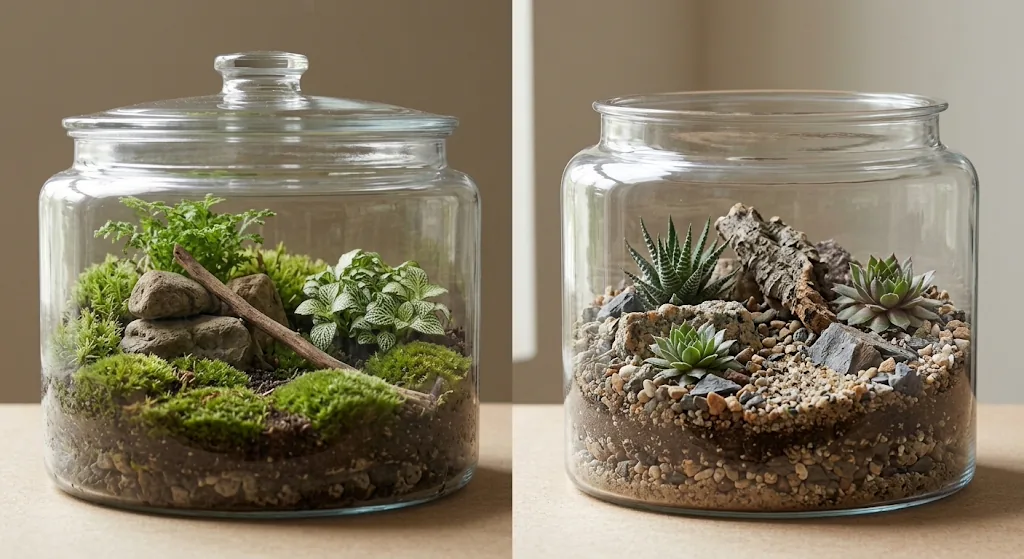
- Check the succulent container’s drainage Keep a real water outlet and removal access in the plan.
Which arrangement matches your goal?
- Humid foliage with less water escaping
- Choose an openable closed garden
Use when the plants’ moisture and light needs overlap and you can lift the lid to inspect and manage growth. A closed jar is a poor choice if you want to leave inaccessible plants untouched indefinitely.
- Humid foliage with frequent access
- Compare a partly open or open humid planting
Use when you can keep the chosen roots appropriately moist in your room. More accessible foliage or individual pots can simplify care, but the opening can increase water loss. Verify the actual plant position.
- A bright arrangement with drying roots
- Choose an open succulent display with drainage
Provide the named plants’ light and wet–dry routine. A freely draining pot you can remove is easier to empty than a sealed-base glass jar. Keep moist groundcovers out of a connected drying bed.
- A supported air plant
- Choose an open, removable mounting position
Verify ventilation at the plant and let it dry between waterings. A gap above an enclosed mounting point does not settle this requirement. Use the air-plant guide for the actual watering and glass-return routine.
Evidence[5]
Keep three different checks separate
Humid air is not a waterlogged root zone
The lid mainly changes the exchange of air and moisture with the room. It does not create an outlet through the base. A draining mix inside sealed glass still cannot discharge excess water outside it.
Separate pots can let you water roots independently, provided the pots drain and do not sit in collected water. They still share the enclosure’s light and air. A drying root pot alone does not turn a humid enclosure into a suitable succulent display.
Air exchange and movement among leaves are different
An opening allows exchange with the room. Air circulation describes movement inside the enclosure and around leaves. The American Orchid Society describes fan-driven movement within enclosed growing spaces, showing why enclosure and circulation are separate questions.
For a small planting, inspect leaf wetness, overlapping growth, and access rather than assigning an airflow score from the lid. An open top can coexist with crowded wet foliage. A closed lid by itself does not prove that air is motionless between leaves. The orchid guidance does not set a fan requirement or airflow threshold for every terrarium.
Lid position does not choose the light
A humid foliage jar needs the light its plants can use without overheating in direct sun. Many drying succulents need brighter conditions; air plants generally need bright diffused light. Choose the plant position first, then check whether the container can work there.
Specialist plants can add water-quality, root-medium, or seasonal requirements. A lid cannot settle those choices. Follow the named plant’s guidance instead of treating every tropical, cactus, or carnivorous label as one care group.
- Compare specialist carnivorous-plant requirements Check light, water, root medium, and seasons separately from the opening.
Make these checks before committing to the glass
Can you change an existing garden from closed to open?
You can change the opening, but the plants keep their needs. Recheck the environment after the change instead of inheriting the old watering routine.
- You remove the lid from a humid planting
- Watch for faster moisture loss
- Check
- Inspect moisture around the roots and the plants after changing the opening.
- Action
- Keep the rooted medium within the selected plants’ requirements. If you cannot maintain those conditions, use more shelter or a different arrangement.
- Stop or reassess
- Do not add succulents to the existing moist bed just because the lid is off.
- You add a lid to an open display
- Recheck every plant’s air and drying needs
- Check
- Identify plants that depend on open ventilation, draining roots, or drying after watering.
- Action
- Keep a succulent or air-plant arrangement open when closing would prevent its required care. Choose suitable humid plants for a closed garden instead.
- Stop or reassess
- Do not seal an arrangement only to reduce your watering work.
- You open the lid to correct excess moisture
- Treat it as an adjustment, then reassess
- Check
- Look at the medium, collected water, and foliage as well as condensation.
- Action
- Pause added water while the planting is wet; allow excess moisture to escape and remove dead material. Recheck conditions before replacing the lid.
- Stop or reassess
- Persistent saturation or inaccessible wet growth calls for changing the planting or container, rather than repeating a fixed opening timer.
Your next step
- Turn the environment into a layoutChoose a source-based humid, drying-rosette, or supported-air-plant design.
- Build the environment you chosePrepare materials, plant, and observe the completed setup.
- Match plants to the environment you choseBrowse names, documented conditions, and display comparisons with defined care conditions.
Continue your terrarium plan
More detail when you need it
- Choose a vessel with usable accessCompare openings, growing space, lids, and the route for water and maintenance.
- Understand low-maintenance limitsSee what recycling can do and why a removable lid still matters.
- Check usable space and future growthCompare footprints, headroom, and maintenance access before buying a small container.
Explore more in build
Sources and review
- Terrariums and bottle gardens · Royal Horticultural Society
- How to Create and Care for a Terrarium · Iowa State University Extension and Outreach
- Plants and Youth: Designing and Building a Terrarium · University of Florida IFAS Extension
- How to grow houseplant cacti and succulents · Royal Horticultural Society
- Air plants · Royal Horticultural Society
- Air Movement · American Orchid Society
- Aloe vera — root moisture and growing conditions · NC State Extension