Build / Understand the system
What is a terrarium? A living garden inside a clear container
Understand what the container changes, how water moves, and what a small garden still needs from you.
By Terrarium GuideSources & editorial method
The short answer
A terrarium is a small garden of living plants grown inside a transparent glass or plastic container. In a closed terrarium, a lid holds in moisture, creating humid air and allowing water to circulate between the plants, growing medium, and container walls. Open terrariums exchange air and lose moisture more freely.
Use one to grow and observe a miniature planted landscape, especially when suitable plants need more humidity than the room provides. It still needs light, appropriate root conditions, growing room, and care. A lid can reduce watering; it does not guarantee a permanently balanced, maintenance-free ecosystem.
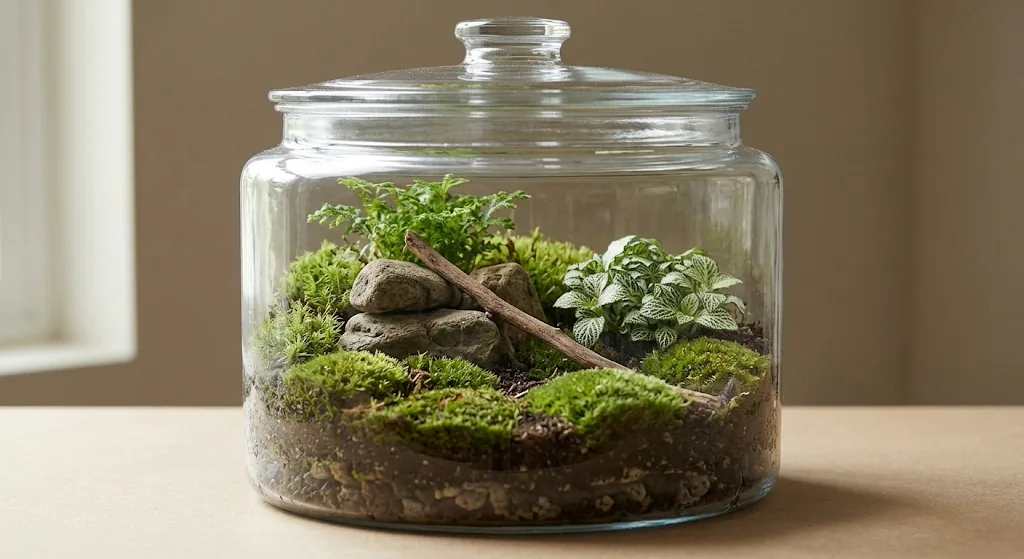
Look for the container, planted floor, and room to grow
The container changes the garden’s surroundings. The plants still need conditions that suit them.
Scope and important limits
A useful fit when
- Understanding a plant terrarium before choosing plants or a container.
- Distinguishing a humid enclosed garden from an open plant display.
Use another path when
- Animal enclosure design or aquatic husbandry.
- A universal planting recipe or a promise of permanent sealing.
This guide uses terrarium in the gardening sense. It combines horticultural guidance and plant biology, rather than reporting Terrarium Guide growing trials.
What makes it a living garden?
- A transparent containerGlass or clear plastic admits light and lets you observe the plants. Jars, cases, and repurposed tanks can serve this role. A wide opening also makes planting and maintenance easier.
Evidence[1]
- Find plants by their growing conditions Narrow your choices before arranging a garden.
How does water circulate in a closed terrarium?
The same water moves through several places and forms. A lid reduces how much escapes into the room.
Water recycling still depends on light and living processes
During photosynthesis, plants use light, carbon dioxide, and water to make sugars and release oxygen. Respiration uses sugars and oxygen to release energy for living cells, producing carbon dioxide and water. Respiration continues in the light and in darkness.
These processes explain how a garden can recycle materials while receiving energy from outside. They do not establish that any sealed combination will stay balanced. Light, temperature, plant growth, and root conditions still matter.
Condensation shows water changing form. It does not measure the moisture around every root or prove that every plant is healthy. Check the planting as well as the glass.
Does a terrarium have to be sealed?
No. Gardening sources use the term for enclosed gardens and open container displays. The important difference is how the opening changes air exchange and moisture loss.
- Closed: a lid retains moisture around a humid planting. Keep it removable for inspection and adjustments.
- Partly open: a gap or narrow opening lets some moisture escape. Actual humidity depends on the vessel and room; a gap is not a fixed growing condition.
- Open: an uncovered display exchanges air with the room more freely. It can hold a humid planting or a drying arrangement, depending on the plants and root care.
- Choose between closed, partly open, and open environments Compare moisture retention, roots, light, and the work each arrangement needs.
- Compare the open-display care directions Separate humid roots, drying succulent roots, and air-plant support.
Terrarium, aquarium, and vivarium: what do the names tell you?
Names overlap across gardening and animal keeping. Check what lives inside and which environment is being maintained.
| Term | Meaning here | Practical distinction |
|---|---|---|
| Plant terrarium | A land-based miniature garden inside a clear container. | Leaves grow in air; rooted plants use appropriate medium. A potting bed is not intended to be submerged. |
| Aquarium | A container for living aquatic plants or animals. | The inhabitants live in a water-based environment. An empty aquarium tank can instead hold a plant terrarium. |
| Vivarium | Also used for animal enclosures; Merriam-Webster defines it as a terrarium used especially for small animals. | A name does not establish a safe animal habitat. Plant advice does not specify animal heating, ventilation, space, or other husbandry. |
Less frequent watering is only one part of care
Choose your next step
- You want a humid garden with a removable lid
- Compare closed-terrarium plants
Match retained humidity with root moisture, growth, and maintenance access.
- You prefer an open humid planting
- Compare open-terrarium plants
Choose growing roles and root arrangements for the actual opening and room.
- You want succulents
- Check drainage, light, and drying first
Plan an open display with real drainage. Removing a lid does not make a wet bed suitable.
- You want an air plant in glass
- Plan accessible support and drying
Use an open arrangement that lets you remove the plant for watering and drying.
Your next step
Continue your terrarium plan
Explore more in build
Sources and review
- Plants and Youth: Designing and Building a Terrarium · University of Florida IFAS Extension
- Terrariums and bottle gardens · Royal Horticultural Society
- How to Create and Care for a Terrarium · Iowa State University Extension and Outreach
- Make your own terrarium · Royal Botanic Gardens, Kew
- Plant growth and development · Oregon State University Extension Service
- Tillandsias as Houseplants · Penn State Extension
- Aquarium: definition · Merriam-Webster
- Vivarium: definition · Merriam-Webster