
Plants / Flame violet
Flame violet in a terrarium: keep runners, roots, and air under control
Episcia cupreata can form new rosettes at the ends of runners; choose where those runners may grow.
By Terrarium GuideSources & editorial method
Botanical identity: Episcia cupreata
The short answer
Flame violet, Episcia cupreata, can be considered for a warm humid display with bright indirect light, well-drained roots, and gentle air movement. Its rosette sends runners that can root into neighboring space, so keep the edges accessible.
Keep the medium moist during active growth without excess water, keep leaves from staying wet, and reduce watering as growth slows. Choose a removable pot or reachable boundary if you need to stop plantlets from filling a shared bed.
Choose whether runners may spread or must be contained
| Role | Decision | Required management |
|---|---|---|
| Reachable spreading ground layer | Use only if its growing footprint fits. | Keep runners away from neighboring crowns and inspect new rosettes. |
| Removable shallow pot | Simplifies separate watering and removal. | Keep runners from bridging the rim into shared soil. |
| A crowded closed planting | Do not rely on humidity alone. | Wet foliage and insufficient air movement can cause decline. |
| Cool display or dry succulent bed | Choose a separate arrangement. | Warmth and moist-root care are not resolved by a shared decorative container. |
Scope and important limits
A useful fit when
- Choosing, planting, and maintaining the named plant in the conditions described here.
Use another path when
- Transferring these conditions to an unidentified retail plant or assuming a permanent sealed display.
Published horticultural guidance and its application to display care; no Terrarium Guide growing trial is claimed.
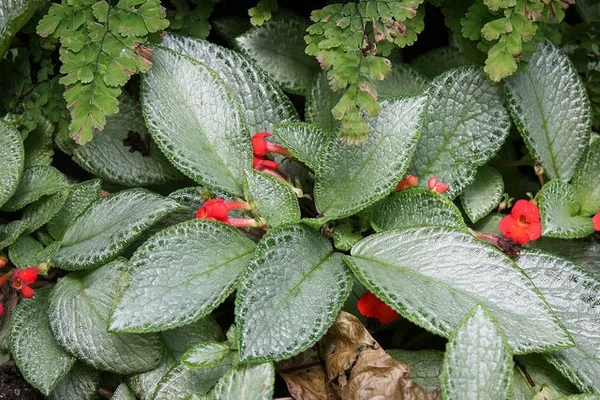
A rosette can become a network of rosettes
This profile covers Episcia cupreata. The source photograph shows ‘Silver Sheen’, one cultivated foliage appearance, not a guarantee that a shop plant has that identity. Related cultivated-form descriptions retain their own labels.
Published ordinary dimensions are about 8–12 in. (20–30 cm) high and 1–2 ft (30–61 cm) across. The important expansion route is the stolon: a runner can form a new rosette at its end. A source’s slow growth category is not a promise that the plant will remain within its initial pot circle.
Inspect the rooted rosette and its runners
- Confirm the name and cultivated form if suppliedDo not assign the pictured ‘Silver Sheen’ identity to every metallic-leaved Episcia.
- Look beneath the leaf layerCheck for pests, wet decay, soft crowns, and dead material. Distinguish a rooted plantlet from a loose runner tip.
- Protect warmth during transportPlan a stable warm position and appropriate cold-weather shipping protection before buying.
- Compare named plants before ordering Keep the identity and specimen checks above; compare seller information, arrival forms and delivery before ordering.
Keep the starting crown and runner boundary visible
Choose warm bright indirect conditions
Avoid full direct sun and leave room for air around the foliage.
Prepare moist well-drained medium
Keep a separate pot’s outlet functional. Do not surround the roots with a standing-water reservoir.
Set the rootball at its existing level
Support the rosette, keep leaves above the soil, and position existing runners where they can be inspected.
Water the root area as needed
Check actual moisture first and avoid soaking the leaves. Clear loose debris and keep a visible boundary beside neighboring plants.
- Prepare a display with the required access Choose the assembly route while preserving Episcia’s air, root and runner conditions here.
Keep the plant warm without trapping wet foliage
Use warmth appropriate to the plant, with roughly 70–80°F (21–27°C) days and nights around 65°F (18°C) or warmer in the reviewed guidance. Chilling can damage growth. These cultivation recommendations are not an instruction to heat a closed jar in direct sun.
Maintain moist medium during active summer growth and water more sparingly as winter growth slows. Check the actual roots and drying rather than using the season alone to decide. Excess water remains a problem even when the surrounding air is humid.
Keep foliage reasonably dry and give it gentle air movement. If a low mat becomes crowded, open access and remove encroaching growth; repeatedly misting a dense canopy does not correct poor circulation.
Keep a plantlet, or stop it before it roots
Trace the runner back to the parent
Follow the thin connecting stem from the small daughter rosette back to the parent. The runner is the connector between them, not a leaf stalk. Keep both growing centers visible. If you cannot trace the connection without pulling or damaging a neighbor, lift the plant out before cutting.
Remove unwanted runners selectively
Routine pruning is not always required, but a confined display needs control of stems crossing the assigned footprint. Use clean tools and remove loose pieces.
Root wanted plantlets separately
Rest the base of a healthy daughter rosette against its own moist drained medium, with leaves and center above it; leave the runner connected without tension. Once actual roots hold the plantlet in that pot, cut the connector between parent and daughter with clean scissors. Keep the daughter’s rooted base and growing center intact; do not cut through the rosette or use a fixed day count as proof of rooting.
Move or renew a crowded planting
If the parent rosette and rooted offspring cannot be reached independently, lift and simplify the planting. Leaf and stem cuttings are also documented propagation methods; keep that rooting work separate from an already crowded display.
Check warmth, roots, and air before treating the leaves
| Observation | Check | Action |
|---|---|---|
| Leaf or shoot dieback in wet crowded growth | Air movement, leaf wetness, and root saturation. | Remove dead material, improve spacing, and correct excess water. |
| Decline after a cold move | Temperature at the plant and transport exposure. | Restore stable warmth; do not force recovery with extra water or feed. |
| A neighbor is covered by new rosettes | Where runners have rooted into its soil. | Separate the offspring or remove encroaching growth. |
| Discolored foliage after direct sun | Light and heat exposure through glass. | Move to indirect light and assess subsequent growth. |
- Trace wet-growth or cold-move decline Check the affected tissue and history rather than adding more water or feed automatically.
Compare conditions and companions
Explore more in plants
Sources and review
- Episcia cupreata — NC State Plant Toolbox · NC State Extension
- Plant of the Week: Episcia cupreata: Flame Violet · University of Arkansas System Division of Agriculture Cooperative Extension Service
- Terrariums — MU Extension Guide G6520 · University of Missouri Extension
- Episcia cupreata — RHS Plant Profile · Royal Horticultural Society
- Episcia cupreata 'Cleopatra' — Flora & Fauna Web · National Parks Board, Singapore
- WFO Plant List 2026-06 · World Flora Online
- How to Create and Care for a Terrarium · Iowa State University Extension and Outreach