Plants / Air-plant displays
Air plant terrariums: choose a plant you can water, drain, and remove
Compare rosettes, swollen bases, and hanging strands with the opening, support, and drying route they need.
By Terrarium GuideSources & editorial method
The short answer
Choose an open, reachable display for an identified air plant. Compare Tillandsia ionantha for a small rosette that can develop into a clump, T. xerographica for a broad curling-leaf focal plant, T. caput-medusae for a swollen-base form, and Spanish moss for hanging strands. Match the actual plant to bright diffused light, airflow at its base, and a removal route; none is a maintenance-free ornament.
For these epiphytic choices, use support rather than burying the plant in soil. Water separately, release trapped water, and let the plant dry outside glass before returning it. A sealed jar or a narrow opening that leaves the crown wet is the wrong display. Humid air does not remove the need for watering or ventilation.
Choose the form you can keep exposed and reachable
| Identified choice | Growing form and light | Choose it when |
|---|---|---|
| Tillandsia ionantha | Small rosettes form pups and eventually a clump. NC State specifies bright indirect light and regular thorough watering despite its humidity requirement. | You can lift out the entire rosette or support, shake excess water free, and allow room for offsets. A small starting specimen does not stay a single fixed-size tuft. |
| Tillandsia xerographica | Broad silvery leaves curl around a large rosette. NC State’s indoor narrative calls for bright light without full sun; a flowering stalk can be 1–3 ft. tall. | You have a broad open rim, canopy clearance, and a way to turn and drain the plant outside glass. Measure the full leaf span, not just the base. |
| Tillandsia caput-medusae | RHS describes curved silvery-green leaves from a swollen bulb-like base, with a reddish flowering spike. Its general air-plant guidance favors bright diffused light. | The base remains visible and accessible for inspection and drainage. A snug shell or deep pocket that holds water around it defeats that access. |
| Spanish moss · Tillandsia usneoides | Adult plants have no roots; branching strands hang from a support. Indoor guidance calls for bright light, humid conditions, and drying between waterings. | You can hang strands freely on reachable wood or another open support, with light and air through the bunch. Do not use it as a wet soil carpet or pack it into a closed globe. |
- Test the support and removal route Choose open hanging support or removable glass placement by the care you can perform.
Scope and important limits
A useful fit when
- Choosing a removable epiphytic air plant for open glass or an open support.
- Planning separate watering, drainage from the foliage, and drying before return.
Use another path when
- Permanently sealed air-plant displays.
- One watering calendar or a size guarantee for every Tillandsia species and hybrid.
These comparisons apply published indoor-care guidance to the actual plant and display. Spanish moss has its own open hanging-display judgment below; the rosette and swollen-base choices do not inherit it.
A rosette needs room beyond its starting size
Ionantha can grow as attached clumps: the photograph shows several rosettes on wood, rather than one permanent miniature tuft. A support may be fixed, but your watering and drying route still has to work. For glass displays, choose a plant and support you can take out together without scraping the leaves.
Evidence[8]
Xerographica: compare the entire leaf span
Reserve room for the curling leaves and any flower stalk. Published dimensions differ: RHS gives a 20–25 cm form in its selection guide; NC State lists a larger horticultural envelope. Neither is a measurement of your specimen or a promise about growth in glass. Use the actual canopy, the identified form, and a future removal route to decide.
Recognize the clumping rosette on its support
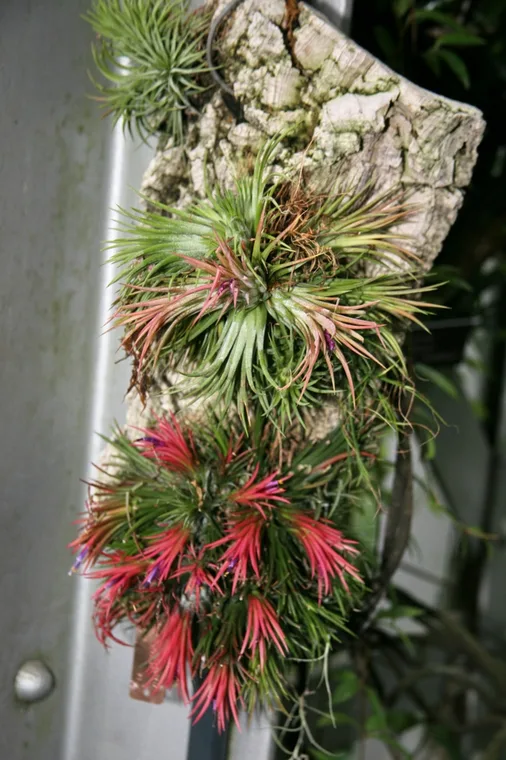
Evidence[8]
Recognize the broad curling-leaf form
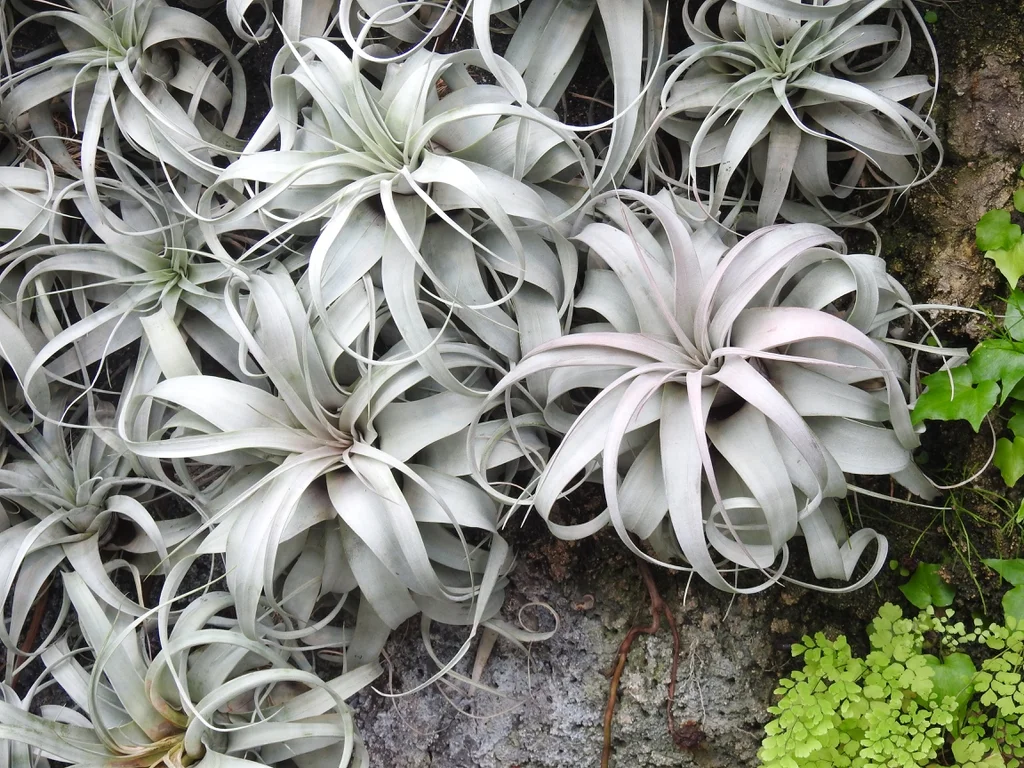
Evidence[9]
Choose the display by its care route
| Arrangement | Care route | Change it when |
|---|---|---|
| Open branch, wood basket, or accessible mount | Keep foliage exposed to light and room air. Hang Spanish moss loosely; angle mounted rosettes so water can leave their crowns. | Dense strands or a hidden base cannot dry or be inspected. Reposition or reduce the bunch rather than assuming the whole mount has airflow. |
| Open glass dish or globe with removable plant/support | Take the plant out for watering and drying. Keep it clear of collected water and return it only after the foliage and crown have dried. | The opening cannot pass the full plant, or the pocket remains damp. Use a wider opening or an open support. |
| Permanent adhesive or tight enclosing decoration | Attachment must not prevent water release or necessary access. For this removable-glass plan, use a lift-out support rather than fastening the plant inside the vessel. | You cannot inspect, drain, or remove the plant. Change the mounting method before choosing the specimen. |
| Mount above a humid planted bed | The air plant has a separate support and watering task; inspect air movement at that exact position. | The wet bed or crowded foliage keeps the mounted plant continuously damp. Choose a separate display instead. |
| Closed bottle or sealed globe | This page’s epiphytic choices need a ventilated position and drying after watering. | A sealed vessel cannot provide that routine. Choose an open support or a different humid rooted-plant plan. |
- Check a mount beside a humid planting Read the specific conditions for Spanish moss near a partly open container.
- Choose rooted plants for a humid closed display Compare openable-container choices and their required management.
Spanish moss on a continuously open support
This hanging display differs from returning a rosette to glass. Check the actual strand density, light, airflow, and support; the judgment applies to Spanish moss in these conditions.
Candidates for these conditions
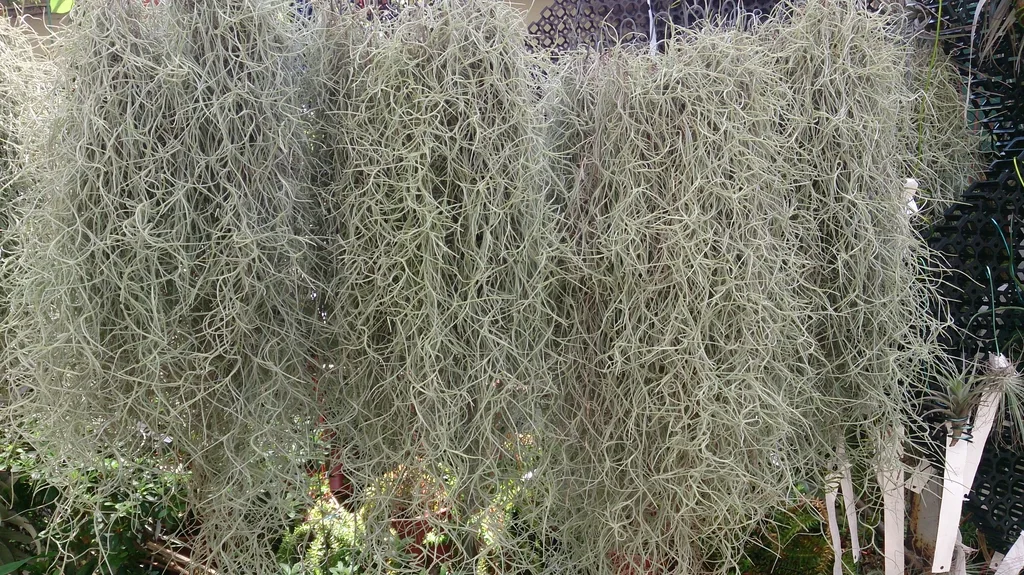
Suitable for this scenario
Tillandsia usneoides
A suitable open hanging-display choice when kept out of soil, in bright indoor light with good air movement, and allowed to dry between ordinary waterings. This continuously open support has no fixed four-hour timer.
Read the plant profileOpen hanging support, without a soil bed
Continuously open hanging support, with the actual strand clearance and conditions checked.
Continuously open hanging epiphyte, removable for maintenance.
- Planting zone
- Open epiphytic support; no soil-root zone.
- Check at the plant position
- Light at the actual strands; Air movement at the mount; Support strength; Drying after watering; Humidity at the strands
Required care and access
- Secure the strands on open wood support; verify light, support strength, and air exchange.
- Let strands dry in open air after watering and between normal waterings. Do not interpret four hours as a deadline or fixed duration for this support.
Remove, water, drain, dry, then return
Choose the method for the identified plant and your room conditions. Light, season, temperature, and humidity change the interval; “air plant” is not a no-water label.
Use a named method, not a universal soak
NC State calls for thorough regular watering for ionantha. Its xerographica indoor profile gives a 15-minute soak, roughly every one or two weeks, less in winter, with adjustments for household humidity. Iowa State’s general guide gives a longer 30–60-minute immersion. These are different guidance scopes, not times to average or impose on every plant. Start with the identified species’ guidance and observe hydration and drying.
Release water held among the leaves
Gently shake free excess water; let a rosette drain upside down in an airy place. Inspect the crown and swollen bases for trapped water. Use room-temperature water; RHS favors rainwater and cautions against hard tap water. A light decorative mist is not the same as thorough watering.
Check drying before putting it back
Illinois advises several hours of drying before return to a terrarium. Penn State specifies at least four hours outside glass; wait longer if the crown, leaf bases, or dense strands remain damp. This is a minimum before returning to glass, not a promise that the plant is dry after four hours. Leave a plant on a continuously open support to dry between waterings without applying that glass-return timer.
Check the plant before adding more water
- Leaves curl or tips brown
- Compare hydration and drying conditions.
- Check
- Xerographica naturally has curled leaves; curling alone is not a diagnosis. Review recent watering, heat, humidity, and light alongside a change from the plant’s usual appearance.
- Action
- If the plant is dry, use its watering method and improve the routine. If the crown is wet, drain and dry it before considering more water.
- Stop or reassess
- Do not keep soaking a wet plant because its naturally curved leaves have not straightened.
- Crown darkens or remains wet
- Inspect retained water and poor airflow.
- Check
- Look between leaf bases and at contact with the support. Darkened tissue can be associated with rot; this is a check, not a confirmed diagnosis.
- Action
- Remove it from the damp enclosure, release retained water, and improve ventilation. Reconsider any support that hides the base or keeps it wet.
- Stop or reassess
- Avoid another soak while the base is still wet; persistent decline needs closer identification and assessment.
- New rosettes fill the opening
- Recheck space before the clump becomes trapped.
- Check
- Measure the whole clump and its path out, including the support.
- Action
- Choose a wider display or open support if offsets prevent safe removal. Keeping offsets attached is possible, but needs more growing room.
- Stop or reassess
- Do not assume today’s pot or opening fixes the long-term plant size.
Check identity and the care route before buying
- Distinguish a live plant from decorative mossSpanish moss is a flowering epiphyte, not true moss. Dried craft strands do not become a live plant by wetting them; ask whether the material is living and untreated before choosing it for cultivation.
Evidence[2]
Your next step
Use your plant shortlist
More detail when you need it
- Check the offered specimen and sellerKeep species and support requirements here; confirm arrival form, dimensions, and delivery before ordering.
- Design a low open air-plant cradleRaise a removable support above the dish rim and keep the plant base clear.
- Spanish moss: planting and careMount Tillandsia usneoides in an open display, water living strands, dry before returning to glass, divide a hanging bunch, and inspect crisp or soft growth.
- Compare open display directionsSeparate humid rooted planting, a drying succulent bed, and this supported epiphyte routine.
- Browse recorded plant identitiesDistinguish species names and planting methods without treating matching tags as compatibility.
Explore more in plants
Sources and review
- Air Plants: Tillandsia · University of Illinois Extension
- Tillandsia usneoides — NC State Plant Toolbox · NC State Extension
- Tillandsias as Houseplants · Penn State Extension
- Air Plants — RHS Care Guide · Royal Horticultural Society
- Tillandsia usneoides — RHS Plant Profile · Royal Horticultural Society
- Spanish Moss — UF/IFAS Gardening Solutions · University of Florida IFAS Extension
- WFO Plant List 2026-06 · World Flora Online
- Tillandsia ionantha — NC State Plant Toolbox · NC State Extension
- Tillandsia xerographica — NC State Plant Toolbox · NC State Extension
- All About Air Plants · Iowa State University Extension and Outreach