Care / Watering decisions
How to water a terrarium: check the roots, then choose the method
Decide whether water is needed, where it should go, and when to stop in a humid bed, a draining pot, or an air-plant display.
By Terrarium GuideSources & editorial method
The short answer
Water when the growing medium is becoming too dry for the plants, after checking below the decorative surface. In a humid terrarium without a drain hole, add a small amount carefully to the rooted medium, let it soak in, and reassess before adding more. Stop before the bed becomes saturated or water pools around the plants.
A removable draining pot follows a different method: water outside the glass, let excess water drain, and empty the outer vessel before returning it. Epiphytic air plants need their own watering and drying routine outside the display. Neither fog on the wall nor a fixed weekly reminder tells you when every arrangement needs water.
Should you add water now?
For rooted plants, inspect the actual medium first against the identified plant’s needs. An epiphyte on a soil-free support or a specialist in an intentional water tray uses its separate route below.
- The rooted layer is too dry for the plant
- Water using the right root arrangement
- Check
- Confirm dryness in accessible root medium, not just a pale top dressing. Compare it with the named plant’s moisture requirement.
- Action
- Use controlled additions for a sealed-bottom humid bed, or water and drain a removable pot outside the display.
- Stop or reassess
- Water pools, the bed is already wet, or the plant’s water requirement is unresolved. Do not keep pouring to make the glass fog.
- The root medium is suitably moist
- Wait
- Check
- Look at the plant as well as the medium. Clear glass is compatible with a moist root zone.
- Action
- Keep the current conditions and check again as they change. A reminder can prompt an inspection without triggering a refill.
- Stop or reassess
- A new moisture or plant-condition change gives you a reason to reassess.
- The root medium is wetter than the plant needs and foliage is wilting
- Pause watering and inspect
- Check
- Wilting can accompany overwatering as well as drought. Check moisture, light, heat and the affected plant.
- Action
- Withhold additional water from the wet rooted bed. Inspect deteriorating tissue and whether excess water can leave; opening a humid cover can release moisture but cannot create a drain hole.
- Stop or reassess
- Decline continues or the root zone remains saturated. Inspect the root arrangement instead of trying another dose.
Scope and important limits
A useful fit when
- Watering an established humid rooted terrarium or an open plant display.
- Choosing between a controlled addition, waiting, and inspecting an already wet planting.
Use another path when
- A fixed dose for an unknown vessel and plant assortment.
- Diagnosing root disease or prescribing one routine for all carnivorous plants, orchids, or Tillandsia.
This is source-based guidance applied to the stated root arrangements, not a Terrarium Guide watering trial. Use the identified plant’s requirements when deciding how dry its medium should become.
Check below moss, gravel, and the surface crust
Find an accessible patch of the actual root medium. Feel a little below the surface where you can do so without tearing roots. A dry cover of decorative gravel, or a damp moss patch above a different rooted layer, is not a complete moisture check.
Ordinary houseplant guides describe finger checks one or two inches deep. That depth is not a target to force into every shallow terrarium bed. Match the check to the real root zone, and avoid blindly stabbing through the divider or tightly packed roots.
A nursery rootball and the surrounding mix can hold water differently. Check more than one reachable root area and each separate pot; one dry surface patch does not establish that the whole planting needs water.
For a removable pot, comparing its weight when recently watered and when ready for water can provide another cue. Medium color and leaf condition can help track change, but neither is a measurement by itself. A probe meter is an aid that may be unreliable, not a reason to ignore the plant or pour to a display number.
- Check the named plant’s moisture needs Distinguish continuing moisture from a drying interval before deciding.
- Change access if the bed cannot be checked Choose an opening that lets you inspect the roots and control water.
Choose the water route before the tool
| Your arrangement | When and how to apply water | Where to stop |
|---|---|---|
| Covered humid direct bed, no drain hole | Check root moisture; when needed, add a little to reachable medium and allow it to spread before deciding on more. | At appropriately moist medium. Do not saturate the whole bed or use a lower collection space as a fill line. |
| Open or partly open humid direct bed | Use the plants’ same root-moisture needs, checking more closely as the opening allows loss. Apply water to the medium, not automatically to every leaf. | Before pooling in solid-bottom glass. An open top does not create an outlet below the roots. |
| Removable pot with real drain holes | Lift it out and water at a sink or suitable tray. For drying succulents, wait for the required dry-down first; other plants keep their own threshold. | After water has reached the rootball and excess has drained away. Empty the saucer and outer glass before putting it back. |
| Epiphytic air plant on a removable support | Take it out for the identified plant’s watering method, then drain and allow it to dry in moving air. | Before returning a still-wet base or crown to glass. Do not water decorative sand as though it were rooted soil. |
| Named specialist in a managed water tray | Follow the identified plant’s water-quality, tray-level and seasonal requirements in its separate root pot. | A deliberately managed flytrap tray differs from unwanted runoff. Do not empty it or dry its medium by applying a generic succulent or foliage rule. |
- Use the full air-plant water, drain, and dry sequence Keep species-specific immersion and glass-return conditions with that guide.
- Keep drying roots in a draining arrangement Use the succulent-specific care and light conditions.
Aim where the roots can use the water
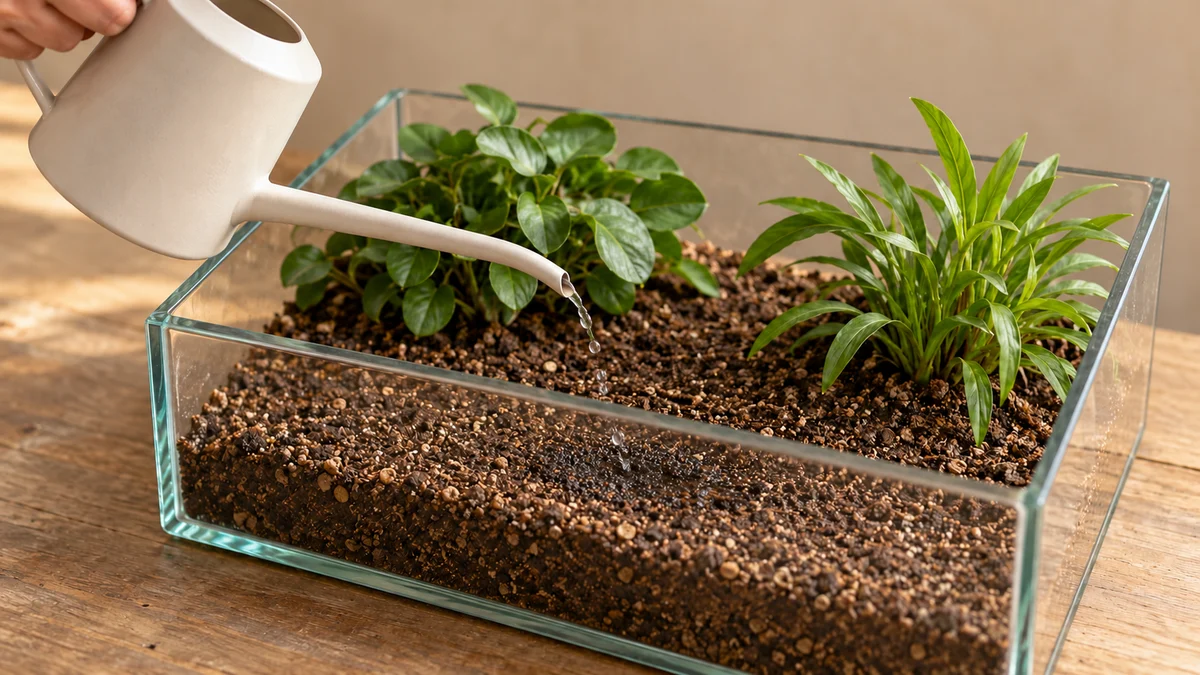
Keep an exposed patch of root medium reachable. A narrow spout can help direct a small flow without showering the whole planting.
Water a humid bed with no outlet
Use this sequence only after the root-moisture check shows a need. It is a controlled addition to solid-bottom glass, not the soak-and-drain method for a flowerpot.
Pause and check the rest of the root area
Allow the addition to soak through before deciding whether another reachable dry patch needs water. Do not judge success from a wet surface alone. Stop when the root medium is appropriately moist; do not continue until the bottom collection layer fills.
Reassess before and after replacing the cover
If excess moisture is present, stop watering and let some escape through the opening. For a stable humid garden after a modest addition, recheck the plants and root medium over the following days; RHS suggests another check a couple of days later. Act sooner if pooling or deterioration is visible.
Water a draining pot outside the display
This is a method for rooted plants in suitable pots with working holes. The plant’s own guidance determines when to use it; it is not a specialist tray or air-plant soaking routine.
Wet the root medium, not just the top
Water slowly across the medium until it is hydrated and excess drains from the holes. If water races down the sides while the pot remains light and the center dry, use slower repeated applications and check again. Suitable removable pots can also be bottom-watered, then removed from the water and drained; do not flood a planted jar to copy that method.
Drain and empty before returning
Allow excess water to finish draining. Empty the saucer and outer glass, then return the pot to its checked position. Next time, check the medium again and follow the identified plant’s required moisture or drying interval; repeated little surface drinks do not replace thorough watering and appropriate intervals.
Keep soil-free and specialist methods separate
- Follow the complete air-plant method Read watering scope, drainage, drying, and return-to-glass conditions.
- Use the flytrap’s own water and feeding guidance Keep water quality and tray care within the named plant’s routine.
How much water should you use?
There is no useful universal number of sprays, tablespoons, or milliliters per liter of glass. Vessel capacity does not tell you the amount of root medium, its current moisture, the roots present, or how much water the cover retains.
For a humid bed without an outlet, use additions small enough that you can stop and inspect before saturating it. Record the amount you actually added with the observed starting condition. That is a reference for your own next check, not a standing dose or a recipe for another jar.
A draining pot has a different stopping point: water should reach the rootball and excess must be able to leave. Do that outside the glass. If very dry potting medium sheds water around the rootball, follow that plant’s rewetting method in its removable pot rather than repeatedly pouring into a sealed-bottom display.
Does misting count as watering?
Count the water that reaches the plant’s required growing surface or root medium, not how wet the air looks. RHS describes a mister as one controlled way to apply water in a humid terrarium; its value is where that water goes, not a particular spray count.
Spraying leaves while leaving dry root medium untouched does not complete a rooted plant’s watering. Conversely, spraying an already moist bed adds water whether or not you call it “just misting.” For drying succulents, repeated shallow sprinkling is a poor substitute for their separate soak-and-drain routine.
Live moss and epiphytic air plants are different growing surfaces, with their own identity and hydration requirements. Keep those instructions with the relevant guide instead of soaking every display whenever one moss patch or air plant needs attention.
- Check live moss and its growing surface Keep living moss separate from dried or preserved decorative material.
- Check the actual air plant’s method A decorative mist and a thorough watering are different actions.
Choose water for the actual plants
Ordinary foliage plants
Iowa State says municipal or well water suitable for drinking works for most houseplants, while sensitive plants can differ. Use room-temperature water and check the named plant’s requirements. Avoid sodium-softened water; do not add a routine fertilizer dose merely because you are watering.
Flytraps and other mineral-sensitive plants
For a Venus flytrap, NYBG specifies distilled, rain, or reverse-osmosis water, warning that tap, bottled, or filtered water can still carry too many dissolved salts. “Filtered” by itself is not a suitability specification.
That water choice does not establish one tray level or moisture cycle for every carnivorous plant. Use the actual species and season; the flytrap’s maintained moist medium is not a reason to keep neighboring succulents wet.
Evidence[11]
Epiphytic Tillandsia
RHS favors rainwater and cautions about hard tap water for air plants. Use the identified plant’s water, hydration and drying guidance outside the display. Do not infer its needs from a generic label or share a fertilizer solution intended for soil-grown foliage.
Evidence[9]
- Keep flytrap water and seasonal care together Use the species-specific medium, tray, light and rest guidance.
- Compare the different carnivorous root methods Separate species and subgroup needs before sharing a water regime.
How often should you check again?
Set reminders to look, then decide from the plant and medium. An interval reported for one arrangement is not a refill deadline for another.
| Situation | What to reassess | What the reminder means |
|---|---|---|
| Established covered humid garden | Root moisture and plant condition; the lid slows loss. | Iowa State suggests checking every few weeks; its months-between-watering example is not a guaranteed wait. |
| Opened cover, changed light, or moved display | How the new position and opening change drying and heat. | Check sooner while learning the new conditions. Do not preserve the old amount automatically. |
| Recent water addition | Whether moisture reached the roots without pooling or persistent saturation. | Recheck after redistribution and again over the following days. Visible excess calls for action sooner. |
| A draining pot or exposed epiphyte | The identified plant’s dry-down or hydration and drying cycle. | Use that plant’s method; a covered jar’s inspection interval does not apply. |
Stop when extra water is becoming the problem
- Check the collection layer and real water route Understand where water can collect and what can actually leave.
- Change an arrangement you cannot manage Keep plant removal and replanting accessible.
Your next step
Correct the underlying conditions
More detail when you need it
- Check visible mold and recurring growthDistinguish surface debris from damaged living tissue, remove affected material, and know when to inspect the plant.
- Check the medium retaining the waterKeep ingredient functions and root requirements with the watering method.
- Understand why a covered jar loses less waterSeparate recycling from permanent balance or a no-care promise.
- Keep the named plant’s requirements with the displayCheck moisture, light, roots, and seasonal instructions together.
Explore more in care
Sources and review
- Properly Watering Container Houseplants — root hydration, dry-medium bypass, and monitoring · Virginia Cooperative Extension
- Growing Dionaea muscipula — low-mineral water and the managed tray · International Carnivorous Plant Society
- Terrariums and bottle gardens · Royal Horticultural Society
- Plants and Youth: Designing and Building a Terrarium · University of Florida IFAS Extension
- How to Create and Care for a Terrarium · Iowa State University Extension and Outreach
- Watering houseplants · University of Illinois Extension
- Watering Indoor Plants · University of Maryland Extension
- Cacti and succulents · University of Minnesota Extension
- Air plants · Royal Horticultural Society
- How to Care for Houseplants · Iowa State University Extension and Outreach
- Venus Flytrap Houseplants (Dionaea muscipula) · New York Botanical Garden — LuEsther T. Mertz Library