Plants / Baby’s tears
Baby’s tears in a terrarium: keep the carpet within reach
Soleirolia soleirolii stays low, but its spreading edge determines whether it belongs beside other plants.
By Terrarium GuideSources & editorial method
Botanical identity: Soleirolia soleirolii
The short answer
Baby’s tears, Soleirolia soleirolii, can grow in a humid terrarium with bright indirect light and moist, well-drained soil. Give the carpet a reachable edge or its own removable shallow pot: low height does not mean limited spread.
Choose another groundcover or a separate layout if you need a small shared bed to stay unchanged. This plant can overrun neighboring plants, and small pieces left behind can grow again. Trimming helps only where you can reach and collect the growth.
Choose how you will contain the mat
| Layout | Decision | Action to plan |
|---|---|---|
| A reachable patch in a humid bed | Workable if you accept active edge control. | Leave visible soil around neighboring crowns and a route for a tool. |
| A removable shallow pot | Easier to lift, divide, and replace. | Keep runners from bridging the rim into the shared bed. |
| A compact shared carpet with Fittonia | The compact-bed plan has a crowding conflict. | Change the members or layout and reassess; do not promise compatibility from similar humidity. |
| An inaccessible bottle or drying succulent bed | Choose another arrangement. | You need access to the spreading edge and a root zone that stays moist. |
Scope and important limits
A useful fit when
- Choosing, planting, and maintaining the named plant in the conditions described here.
Use another path when
- Transferring these conditions to an unidentified retail plant or assuming a permanent sealed display.
Published horticultural guidance and its application to display care; no Terrarium Guide growing trial is claimed.
Tiny leaves are not proof of a tiny footprint
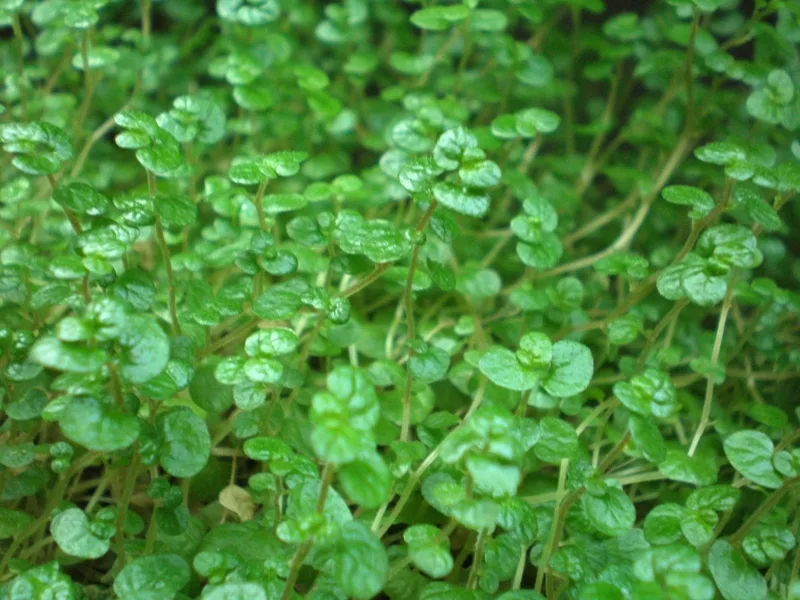
This page covers Soleirolia soleirolii, also found under the older name Helxine soleirolii and the name mind-your-own-business. It is a flowering groundcover, not a true moss. Ask for the scientific name when a shop uses baby’s tears, Irish moss, or Japanese moss.
Published ordinary size descriptions give a low mat about 3–6 in. (8–15 cm) tall. Garden spread can reach several feet; a pot limits contact with new soil. Use that contrast to plan a boundary, rather than treating an outdoor width as a prediction inside your container. The photograph helps you examine the foliage, not identify every retail label.
Inspect the mat and its underside
- Confirm Soleirolia and the actual rooted areaA dense top can hide a much smaller rootball. Check the soil and the underside before selecting a piece for glass.
- Choose a piece you can remove againTest the vessel opening against the rootball, your tool, and the route past other plants.
- Check fresh edges and hidden debrisLook for healthy new tips, pests, soft growth, and dead material trapped underneath. Keep a suspect purchase separate for inspection.
- Compare living groundcover purchases Keep the identity and specimen checks above; compare seller information, arrival forms and delivery before ordering.
Start with a small rooted patch and an inspectable edge
Prepare the position
Use indirect light and keep glass away from hot direct sun. Choose a patch where the mat can expand without immediately covering another crown.
Set the rooted piece at its current level
Use moist, fertile, well-drained medium. Support the shallow rootball rather than pulling the mat by its leaves; backfill without burying the living surface.
Keep a visible boundary
Clear loose stems from neighboring soil. If using a removable pot, keep its drainage outlet clear and prevent the rim from becoming a bridge.
Check the roots before watering
Feel the medium beneath the edge. Add water gradually if needed; humid air and glass condensation do not tell you whether that rootball is dry.
- Prepare the bed before placing the mat Use the vessel and material sequence while retaining the containment boundary described here.
Keep the roots moist without hiding a wet problem
Provide bright indirect light and humid air. Check soil beneath the mat rather than judging only its green surface. A broad carpet can conceal both drying edges and a saturated center. Water the dry root area carefully; if water is standing around roots, remove the excess and restore drainage before adding more.
Use ordinary moderate indoor conditions rather than inventing a species temperature or humidity setpoint from the word tropical. Open an enclosure when wet decay or persistent crowding needs attention. A damp carpet is not a reason to seal it permanently or feed it on a fixed calendar.
Lift the edge; collect every loose fragment
Find the advancing stems
Look around other plants’ bases and beneath the mat. Mark the area you intend to retain before clipping so the remaining boundary is easy to inspect.
Remove growth that crosses the boundary
Support the patch on the side you will keep, then trace and lift the fine stems crossing its boundary. Cut only the unwanted edge with clean scissors, keeping neighboring crowns and roots out of the blades. Retrieve loose pieces onto a dish outside the glass rather than pushing them into neighboring soil. Stop and lift the mat out if its edge is too entangled to separate safely.
Divide a crowded rooted mat
Lift it out if necessary and separate a rooted portion into fresh moist, well-drained medium. Division retains a manageable piece without requiring the whole carpet to remain in the display.
Recheck the cleared ground
Small stems can regrow. Inspect the former edge during subsequent care and remove new shoots before they become another hidden mat. Dispose of unwanted growth responsibly rather than releasing it outdoors.
Check underneath before treating the surface
| Observation | Distinguishing check | Next action |
|---|---|---|
| Crisp or collapsed edge | Compare moisture at the edge and center; check direct sun. | Correct an actually dry rootball and relocate hot glass; retain healthy rooted growth. |
| Soft brown material under green tips | Check for standing water, buried debris, or a suffocated neighbor. | Lift the patch to inspect and remove dead material; correct excess water. |
| Green shoots return in a cleared patch | Look for rooted fragments left in the soil. | Remove the fragments and repeat the boundary check. |
| A neighboring plant is disappearing | Inspect its crown and access to light. | Remove the encroaching mat; separate the plants if the boundary cannot be maintained. |
- Correct unwanted water beneath the planting Keep the living mat’s moisture needs distinct from an inaccessible pool.
Baby’s tears in a crowded compact bed
Plan summary · read the complete conditions
Fittonia and baby’s tears on a compact shared bed
Choose one groundcover when Fittonia and Soleirolia must spread across the same narrow surface without room to keep their growth separate or reach each plant for trimming. Their moisture needs can overlap, but this cramped layout cannot manage the competition. A larger, independently reachable layout needs its own check.
Layout: A narrow, single-level shared surface without separately reachable growing space for both expanding groundcovers.
- Fittonia albivenis
- Soleirolia soleirolii — Fast mat-forming ground cover
A local conflict is not a species-wide ban
Evidence[1]
Compare conditions and companions
Explore more in plants
Sources and review
- Soleirolia soleirolii — NC State Plant Toolbox · NC State Extension
- Terrariums — MU Extension Guide G6520 · University of Missouri Extension
- Indoor Plant Care — Purdue Extension HO-39 · Purdue University Extension
- Mind-your-own-business — RHS Advice Guide · Royal Horticultural Society
- WFO Plant List 2026-06 · World Flora Online
- How to Create and Care for a Terrarium · Iowa State University Extension and Outreach
- Fittonia albivenis — NC State Plant Toolbox · NC State Extension