Plants / Jade plant
Jade plant in an open display: manage a drying root zone and woody crown
Crassula ovata is a branching succulent shrub; plan beyond the small cutting in its nursery pot.
By Terrarium GuideSources & editorial method
Botanical identity: Crassula ovata
The short answer
Grow jade plant, Crassula ovata, in a bright open arrangement with freely draining medium and a real drainage outlet. Water after the soil dries and reduce watering as growth slows. A sealed humid bed is not a substitute for this drying-root routine.
Allow room for a branching woody crown and a stable rootball. A small cutting may be a useful starting plant, but it does not remain miniature automatically. Prune selectively or move the plant when its healthy outline outgrows the display.
Choose an open arrangement that can drain
| Setup | Decision | What makes it usable |
|---|---|---|
| Drained pot in a bright open position | A practical jade growing setup. | Let roots dry between waterings and keep the pot stable. |
| Removable pot inside glass | Useful when roots can be watered separately. | Drain outside the display and empty surplus before return. |
| Undrained bowl with a stone layer | Change the root management. | Stones do not create an outlet for excess water. |
| Shared moist tropical bed | Choose a different partner or arrangement. | Persistent moisture conflicts with jade’s drying root zone. |
Scope and important limits
A useful fit when
- Choosing, planting, and maintaining the named plant in the conditions described here.
Use another path when
- Transferring these conditions to an unidentified retail plant or assuming a permanent sealed display.
Published horticultural guidance and its application to display care; no Terrarium Guide growing trial is claimed.
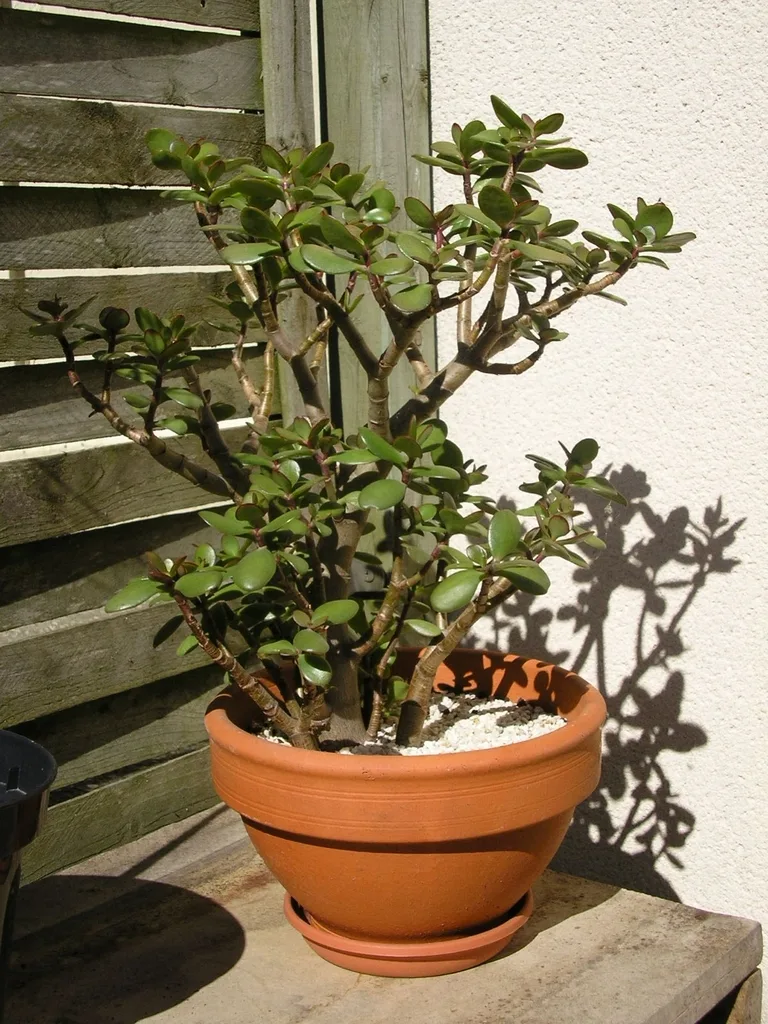
A small jade becomes a branching shrub
This page covers Crassula ovata. Different leaf forms and named cultivars can have different outlines; an unlabeled purchase does not acquire the pictured plant’s exact identity. Other Crassula species sold under overlapping jade names remain separate.
Ordinary species descriptions include heights of 3–6 ft (91–183 cm) and a spread of 2–3 ft (61–91 cm). An indoor managed plant need not reach those figures, but they explain why a nursery cutting is not a permanently tiny tree. Growth descriptions vary from slow to moderate across sources; no calendar rate is inferred.
Check crown width, branch weight, and pot stability. A top-heavy plant needs an appropriate container or repotting decision, not a narrow opening used to hold the branches in place.
Look for firm growth and a stable rootball
- Confirm Crassula ovata and any cultivar nameDo not infer a compact named form from a small nursery pot.
- Inspect joints, leaf undersides, and the stem baseCheck for visible pests, loose damaged branches, soft dark tissue, or medium that remains saturated.
- Allow lifting and later pruningThe rootball, crown, and tools need to pass through the opening. Keep ornamental leaves away from children and pets rather than treating the plant as food.
- Compare named jade plants and arrival forms Keep the identity and specimen checks above; compare seller information, arrival forms and delivery before ordering.
Use a stable pot and a clear drainage outlet
Choose a bright position
Introduce stronger direct light gradually after a shaded nursery position. Keep glass from overheating the plant.
Prepare freely draining succulent medium
Use a pot with an outlet. Plan how all collected water will leave the outer display.
Set the plant at its existing soil level
Support the woody crown and rootball, backfill gently, and keep the stem base visible rather than buried under damp decoration.
Adjust watering to establishment and drying
Inspect roots and medium after handling. A newly repotted plant may need more conservative watering while establishing; do not leave it standing in water.
- Build the complete drying-root display Keep jade’s own light and water instructions with the shared materials and assembly method.
Dry between waterings while keeping enough light
Check the actual medium before watering. During active growth, water the root zone and allow surplus to drain, then wait for it to dry again. During slower autumn-to-winter growth, keep watering more restricted. Succulent leaves store water, but prolonged neglect can still cause decline.
Use bright light and ordinary household humidity with ventilation. A dark humid jar cannot maintain the same compact form as an adequately lit pot. Acclimate outdoor summer moves and return the plant before freezing conditions.
Check daytime and nighttime temperatures where your jade will grow. Published recommendations describe different growing conditions; compare each neighboring plant’s guidance before sharing a position.
Prune to a branch; root cuttings outside the display
Choose the crown outline you can maintain
Look for branches that close access, lean excessively, or shade a neighbor. Work outside glass so the branch can be supported.
Cut selected stems back to a lateral branch
Spring is the documented time for shaping. Use clean tools and preserve a healthy supported framework rather than removing all new growth whenever it touches the vessel.
Let a wanted cutting’s wound dry before planting
Wisconsin’s propagation guidance lets cut pieces dry for several days to reduce rot risk. Place healthy material into a separate freely draining, fairly dry rooting medium rather than a humid shared bed.
Observe actual establishment
Leaf and stem cuttings are documented methods, but a fixed day count does not prove roots. Keep propagation separate, and move the parent if selective pruning cannot preserve usable space.
Check roots and light before treating dropped leaves
| Observation | Check | Action |
|---|---|---|
| Leaf drop with soft stems and wet medium | Drainage, accumulated water, and root condition. | Lift and inspect; stop adding water to wet roots. |
| Wrinkling with a dry rootball | Whether roots remain healthy and the medium can take up water. | Water an established dry plant appropriately and reassess after draining. |
| Long drooping growth | Light reaching the crown and branch support. | Increase light gradually and shape selectively; extra fertilizer does not correct darkness. |
| White insects or cottony material in joints | Close inspection of the plant and neighbors. | Isolate for pest identification and suitable treatment; do not diagnose from color alone. |
- Correct water retained around the root pot Remove unwanted runoff and inspect damaged growth before returning the pot.
Jade’s role in the open Aloe–jade plan
Plan summary · read the complete conditions
Aloe vera and jade in an open succulent display
Aloe vera and jade can share an open, bright display when water has a real drainage outlet and the soil dries between waterings. Check both plants and growing space first; an open top or a stone layer does not drain a glass bowl.
Layout: An open succulent display with enough room for both actual plants, their canopies, and flowering stems.
- Aloe vera
- Crassula ovata — Upright woody focal point
Keep the whole shared plan conditional
Compare conditions and companions
More detail when you need it
Explore more in plants
Sources and review
- Crassula ovata — NC State Plant Toolbox · NC State Extension
- Jade Plant, Crassula ovata · University of Wisconsin–Madison Division of Extension
- Care tips for light-loving houseplants · Royal Horticultural Society
- What is the problem with my indoor jade plant? · Missouri Botanical Garden
- Crassula ovata | jade plant · Royal Horticultural Society
- Indoor Plant Care — Purdue Extension HO-39 · Purdue University Extension
- WFO Plant List 2026-06 · World Flora Online
- Aloe vera — NC State Plant Toolbox · NC State Extension
- Care tips for light-loving houseplants at the RHS Urban Show · Royal Horticultural Society
- Aloe | RHS Plant Guide · Royal Horticultural Society
- Aloe, a Hardy Houseplant · Penn State Extension
- Aloe, Barbados Aloe, Kitchen Aloe | Texas Tech Plant Database · Texas Tech University Plant Resources
- Aloe Vera — Gardening Solutions · University of Florida IFAS Extension
- Aloe Vera · University of Arizona Cooperative Extension
- How to Create and Care for a Terrarium · Iowa State University Extension and Outreach