
Plants / Persian violet
Persian violet in a display: plan the flowering period and replacement
Exacum affine is a short-lived flowering plant; “everlasting” is a sales phrase, not a lifetime guarantee.
By Terrarium GuideSources & editorial method
Botanical identity: Exacum affine
The short answer
Persian violet, Exacum affine, is best planned here as a removable short-lived flowering accent rather than a permanent terrarium foundation. Give it indirect light and moist, well-drained potting medium, with room for the rounded flowering crown.
Remove spent flowers and reassess the plant after flowering. Continued healthy growth is worth keeping, but reliable long-term rebloom is not promised. If your plan requires an unchanged permanent planting, choose a different role or plant.
Decide whether a temporary flowering accent fits your plan
| Your aim | Decision | Care consequence |
|---|---|---|
| An accessible flowering accent | A practical role for a healthy plant. | Keep it removable and inspect the pot throughout flowering. |
| An unchanged long-term shared bed | A poor planning assumption. | The species is short-lived and difficult to maintain after flowering. |
| A pot inside an open decorative display | Makes replacement and watering easier. | The rootball must drain and the whole crown must pass through the opening. |
| A narrow sealed jar | Choose another arrangement. | Crowded flowers, root inspection, and replacement become difficult. |
Scope and important limits
A useful fit when
- Choosing, planting, and maintaining the named plant in the conditions described here.
Use another path when
- Transferring these conditions to an unidentified retail plant or assuming a permanent sealed display.
Published horticultural guidance and its application to display care; no Terrarium Guide growing trial is claimed.
Read “everlasting” as a label, then identify the plant
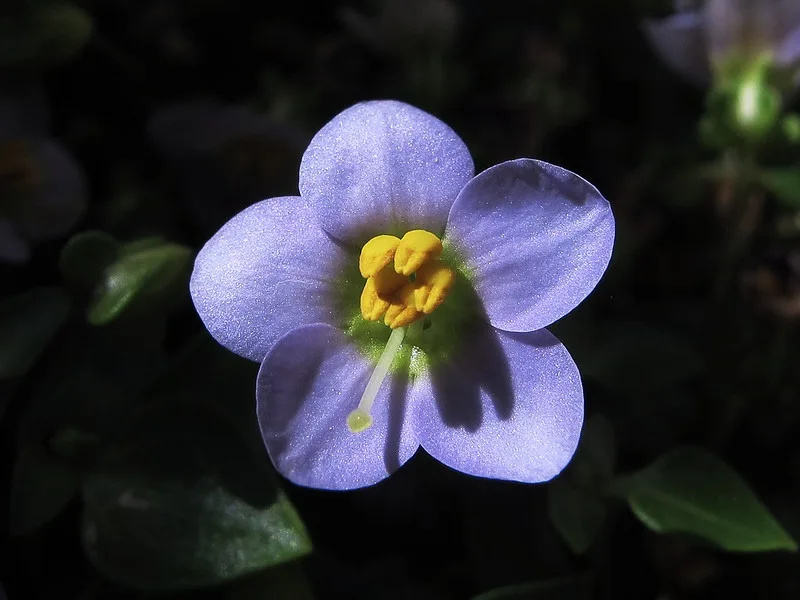
This guide covers Persian violet, Exacum affine, also called Arabian gentian. It is distinct from African violet and flame violet. A shop’s everlasting Persian violet wording does not establish perpetual flowering or an exclusive common-name identity.
This plant forms a rounded bushy crown rather than a trailing groundcover. Ordinary source descriptions give about 6–18 in. (15–46 cm) height and 6–12 in. (15–30 cm) spread. Allow for the flowering outline and a removal route, not just the diameter of the nursery pot.
Buy for the display period you can maintain
- Confirm Exacum affineRetain any cultivated-form label and do not transfer care from another plant called violet.
- Inspect both buds and the plant beneath themChoose healthy foliage and firm stems, with no widespread wilt, hidden pests, or soft wet decay.
- Accept a replacement route before plantingTest the whole pot and crown through the opening. A temporary role still needs a practical way to remove the plant.
- Compare the flowering plant and arrival form Keep the identity and specimen checks above; compare seller information, arrival forms and delivery before ordering.
Keep the flowering plant in a reachable drained root zone
Choose an indirect-light position
Avoid direct sun and heat on glass. Place the rounded crown where flowers can be checked without pressing against the vessel.
Prepare moist, well-drained medium
A removable pot allows watering and drainage outside the display. Avoid a saturated shared bed selected only to raise humidity.
Keep the original planting level
Support the rootball and protect flowering stems. Do not bury lower growth to shorten the plant.
Check water and removal access
Moisten when needed, empty collected surplus, and confirm you can reach finished flowers and lift the pot later.
- Keep the flowering pot removable Test the rootball and crown through the opening before setting up the temporary display.
Keep moisture steady without treating flowers as a watering signal
Check the medium near the rootball and keep it moist with drainage. A flower opening or fading does not tell you whether roots need water. Inspect a wilted plant before watering again, because a saturated rootball can also accompany decline.
The source’s 60–70°F (16–21°C) warm-night guidance concerns outdoor use. It is not a measured indoor terrarium optimum. Choose stable comfortable indoor conditions and avoid direct heat, chilling moves, and hot sun on the vessel.
Its association with humid climates does not prove permanent sealed culture. Keep the crown accessible and clear loose flowers and dead leaves so they do not collect around the stem bases.
Deadhead, then judge the remaining plant
Remove finished flowers carefully
Use clean tools or gentle removal appropriate to the stem, protecting buds and healthy shoots. Clearing spent blooms is documented flowering care.
Keep observing roots and shoots
Look for firm stems and healthy new growth. Do not compensate for a naturally finishing display with more water in an already moist pot.
Cut back after flowering when retaining the plant
The reviewed guidance describes post-flowering cutting back. Keep healthy shoots and maintain drained root conditions; this action does not guarantee repeat bloom.
Replace a declining plant when the role is finished
Lift the whole pot or rooted plant without disturbing the rest of the display. Clean away dead material and recheck the conditions before selecting a replacement.
Separate a finished display from a root problem
| Observation | Check | Next action |
|---|---|---|
| Individual flowers fade while foliage stays healthy | Bud development and finished bloom material. | Remove spent flowers and continue normal root checks. |
| The whole plant wilts | Root moisture, drainage, and recent heat exposure. | Water only if roots are actually drying; inspect a wet rootball before intervening. |
| Few flowers after the original flush | Whether healthy vegetative growth remains. | Retain a healthy plant if desired, with realistic rebloom expectations; replace a declining one. |
| Soft stems or hidden decay | Collected water and debris around the crown. | Remove declining material and inspect outside the display; do not reseal a deteriorating plant. |
- Separate flower turnover from worsening plant damage Keep the complete flower-aftercare instructions here and use the decline checks when other tissue changes.
Compare conditions and companions
More detail when you need it
Explore more in plants
Sources and review
- Exacum affine — NC State Plant Toolbox · NC State Extension
- FPS-208: Exacum affine Persian Violet, German Violet · UF/IFAS Extension
- Exacum affine — RHS Plant Profile · Royal Horticultural Society
- Exacum affine — Flora & Fauna Web · National Parks Board, Singapore
- Exacum — Ornamental Production Guide · Texas A&M AgriLife Extension
- WFO Plant List 2026-06 · World Flora Online
- How to Create and Care for a Terrarium · Iowa State University Extension and Outreach