Plants / Spider plant
Spider plant in a display: leave room for leaves and plantlets
Chlorophytum comosum is easier to manage when its cascading growth and rootball can leave the glass.
By Terrarium GuideSources & editorial method
Botanical identity: Chlorophytum comosum
The short answer
A spider plant is useful as an arching edge plant in a larger open glass display, especially when its runners and plantlets are part of the design. Keep a draining removable pot near the opening so leaves can arch freely and runners can be removed or rooted separately. A baby plant is a temporary small specimen, not a permanent miniature for a sealed bottle.
Use indirect light, moderate root moisture, and ordinary room ventilation. Let the plant’s actual root zone guide watering, reduce water as growth slows, and keep accumulated water away from the pot. A humid sealed bed is not supported merely by its houseplant reputation.
Choose it for arching leaves and visible plantlets
Place the pot near the open edge, with clearance for leaves to arch away from smaller neighbors. If you want runners as part of the scene, leave them in free air or guide a wanted plantlet to a separate reachable rooting pot. Do not let it accidentally root across the whole shared bed.
Keep the crown and pot outlet clear of moss and decoration. Lift the pot to water and inspect congestion; do not dismantle neighboring roots every time an adult plant needs repotting. Remove unwanted runners before they tangle around the hardscape.
For a lower textured accent in a humid bottle, compare a compact Fittonia form and its pinching routine. For a dry succulent bowl, choose plants from the succulent comparison instead: neither a small spider-plant offset nor a separate pot makes a drying sunny bed its natural care match.
- Compare the smaller humid-plant alternative Check its own environment, growth and planting method before substituting.
Scope and important limits
A useful fit when
- Choosing, planting, and maintaining the named plant in the conditions described here.
Use another path when
- Transferring these conditions to an unidentified retail plant or assuming a permanent sealed display.
Published horticultural guidance and its application to display care; no Terrarium Guide growing trial is claimed.
Choose the plant stage and its next move
| Starting plant | Useful role | What must happen as it grows |
|---|---|---|
| A rooted plantlet | A smaller starting plant for a reachable position. | Leave space for a larger rootball and arching leaves; plan repotting. |
| An adult rosette | A broad foliage focal point. | Measure width and allow runners to hang without tangling neighbors. |
| A removable pot within an open display | Allows separate watering and relocation. | Keep a clear outlet and a safe lifting route. |
| A narrow bottle or permanently wet bed | Change the arrangement. | Leaf clearance, roots, and normal ventilation become difficult to manage. |
The crown grows wider than a baby plant suggests
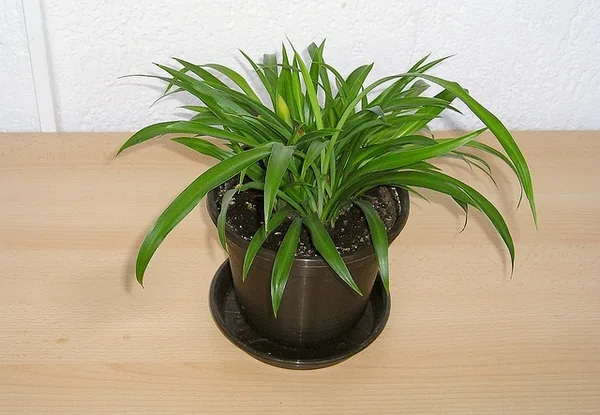
This page covers Chlorophytum comosum. Green and variegated cultivated forms differ in appearance, and an unrecorded cultivar does not acquire a specific size from the photo. NC State’s ordinary species dimensions are about 1–1½ ft (30–46 cm) tall and 1–2 ft (30–61 cm) wide.
Leave room for the leaves to arch and for long runners to bear plantlets. A runner touching shared soil can create another rooted plant. Decide whether you want that expansion before letting it cross the edge of a removable pot.
Choose a healthy rooted plant, not just a loose offset
- Check roots and the center of the rosetteA detached plantlet needs roots established before it can be treated like a mature potted plant. Avoid soft or damaged crowns.
- Inspect leaf undersides and root congestionCheck for visible pests and whether the pot is packed with roots before planning the new container.
- Measure the opening with the leaves in mindThe whole rosette must be removable without folding every leaf against glass.
- Compare labeled plants and shipping forms Keep the identity and specimen checks above; compare seller information, arrival forms and delivery before ordering.
Set the crown above an aerated root zone
Choose indirect indoor light
Avoid scorching direct sun on glass. Check where arching leaves will sit once the plant is positioned.
Prepare a drained potting medium
Use a pot with a water outlet where possible. A decorative outer glass container should not become a standing-water reservoir around the roots.
Support the rooted plant at its existing level
Keep the central crown clear and gently backfill the roots. Do not bury foliage to shorten the outline.
Water according to the medium
Moisten a drying rootball and let surplus drain. Empty collected water before returning the plant to its display.
- Check access for the pot and runners Use the vessel test before the rootball or offspring block removal.
Moderate moisture, warmth, and room air
Keep moderately moist roots with drainage. Drought tolerance does not make repeated complete drying a preferred routine. Check soil and pot weight together, and reduce watering as winter growth and drying slow.
Colorado State gives a daytime houseplant preference of 65–75°F (18–24°C). Keep the display away from cold drafts and direct heating or air-conditioning blasts. Published cold-protection figures from different sources are not a common growth optimum or a freezing-survival promise.
Do not increase fertilizer to force runners from a stressed plant. Inspect light, roots, and growth first. Excess feed and dissolved salts can contribute to tip problems; water quality is only one possible cause.
Root a plantlet before cutting the runner
Choose a healthy plantlet
Use one that can sit against a separate small pot of moist, drained medium without straining the connecting runner.
Keep the plantlet in contact with the medium
Support it at the soil surface with the crown clear. Keep the small root zone appropriately moist while roots establish.
Separate after rooting
Find the thin runner between the parent and the daughter plantlet; keep the daughter’s leafy crown and rooted base intact. Once its actual roots hold it in the separate medium, support it and cut that connecting runner with clean scissors, between the two plants. If the plantlet lifts free because it has not rooted, keep it connected and allow rooting to continue. A fixed number of days is not proof of rooting.
Remove unwanted runners for containment
If you do not want more plants, remove unwanted runners before they tangle or root into neighboring soil. Repot or divide an adult whose roots outgrow the display.
Brown tips need a cause check before cosmetic trimming
| Observation | Distinguishing check | Next action |
|---|---|---|
| Brown tips with otherwise healthy growth | Water quality, feeding history, salts, and irregular moisture. | Correct the observed cause; trim dead tips for appearance if desired. Dead tissue does not recover. |
| Yellow or soft leaves with wet medium | Drainage, collected water, and crown condition. | Lift for inspection and stop adding water to saturated roots. |
| Slow growth with a crowded rootball | Root space and the light reaching the leaves. | Repot or divide rather than compensating with more feed. |
| Plantlets overrun another pot | Which runners are rooting into neighboring medium. | Separate the rooted offspring or remove unwanted runners. |
- Review feeding and salt history before another dose Keep this plant’s water-quality checks here; use the general correction limits for pots and solid glass.
Compare conditions and companions
Explore more in plants
Sources and review
- Chlorophytum comosum — NC State Plant Toolbox · NC State Extension
- Indoor Plant Care — Purdue Extension HO-39 · Purdue University Extension
- Spider Plant — PlantTalk Colorado 1328 · Colorado State University Extension; Denver Botanic Gardens; Green Industries of Colorado
- Spider plant (Chlorophytum comosum) — New York Botanical Garden Research Guides · The New York Botanical Garden
- Spider Plant — UF/IFAS Gardening Solutions · University of Florida IFAS Extension
- Spider plant, Chlorophytum comosum — Wisconsin Horticulture · University of Wisconsin–Madison Division of Extension
- Why does my houseplant have brown leaf tips and edges? — Iowa State University Extension and Outreach · Iowa State University Extension and Outreach
- WFO Plant List 2026-06 · World Flora Online
- How to Create and Care for a Terrarium · Iowa State University Extension and Outreach
- Fittonia albivenis — NC State Plant Toolbox · NC State Extension