Plants / Spanish moss
Spanish moss in a display: hang, water, and let the strands dry
Tillandsia usneoides is a rootless air plant; its living strands need light and moving air, not a bed of soil.
By Terrarium GuideSources & editorial method
Botanical identity: Tillandsia usneoides
The short answer
Spanish moss, Tillandsia usneoides, is a flowering air plant, not true moss. Hang living strands where they receive bright light and free air movement. Adult plants do not need a root bed, so do not bury them in soil or pack them against a wet surface.
For a glass display, remove the plant to water it, then let the strands air-dry outside glass for at least four hours before returning them, and keep waiting if they remain wet. This is a minimum before glass return, not a drying deadline. A continuously open hanging display needs drying between waterings, without a universal four-hour timer.
Choose a support that leaves the strands exposed
| Support or display | Decision | Required check |
|---|---|---|
| Open hanging support | A useful way to expose the strands to light and air. | Separate dense bunches enough to inspect the interior. |
| Removable support in open glass | Allows watering and drying outside the vessel. | Check removal without snagging and return only after the minimum wait and actual drying. |
| Tightly packed wet ball or permanently closed jar | Change the arrangement. | Retained moisture and poor air movement undermine the drying routine. |
| Buried in a rooted planting bed | Use an exposed support instead. | Adult Spanish moss takes up moisture through its living surfaces rather than a soil rootball. |
Scope and important limits
A useful fit when
- Choosing, planting, and maintaining the named plant in the conditions described here.
Use another path when
- Transferring these conditions to an unidentified retail plant or assuming a permanent sealed display.
Published horticultural guidance and its application to display care; no Terrarium Guide growing trial is claimed.
Buy living Tillandsia, not preserved decoration
This page covers Tillandsia usneoides. It is a bromeliad with rootless adult growth, not a true moss, lichen, or living soil cover. Confirm that a product is living plant material; dried or preserved decorative Spanish moss cannot be brought into active growth by following this care.
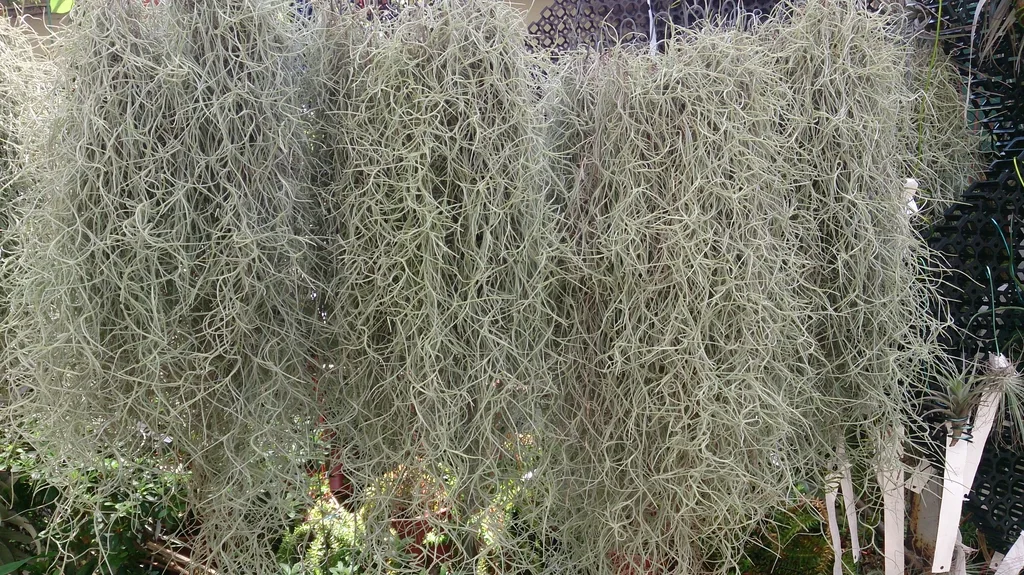
Branching stems form hanging silver-gray strands. Short indoor bunches and long natural drapes differ greatly in length, so ordinary source dimensions do not impose a final display size. Allow the bunch to lengthen without reaching soil, standing water, or a neighboring crown.
The silver appearance is part of the plant’s surface structure, not proof that every pale strand is healthy or dry. Examine suppleness and the interior of the bunch alongside its color.
Check the living bunch all the way through
- Ask for living Tillandsia usneoidesAvoid substituting preserved, dyed, or dried craft material for a living plant.
- Inspect the interior and attachment pointLook for living flexible strands, dead debris, pests, and a wet compacted center. Do not judge only the attractive outer drape.
- Choose a support you can liftCheck the full route past the vessel edge and other plants. You need access to water and dry the whole bunch.
- Compare living Tillandsia and decorative products Keep the identity and specimen checks above; compare seller information, arrival forms and delivery before ordering.
Hang loosely, without burying the living strands
Choose bright light with air around the plant
Keep it away from a dark sealed corner or hot glass. Check light reaching the interior as well as the outer drape.
Use an exposed suitable support
The species guidance lists branches, driftwood, and open baskets. Arrange strands loosely enough that the middle can be inspected.
Keep the lowest growth above wet surfaces
Do not bury the ends in ordinary soil or rest them in a reservoir. Leave clearance for future length.
Test removal before the arrangement is finished
Lift the bunch without snagging or pulling strands through hardscape. Revise the support if watering would require dismantling other plants.
- Build an accessible soil-free display Use the support and assembly route while retaining the hanging plant’s separate watering and drying.
Water outside glass and check the center before returning
Remove the bunch or support from glass
Expose the whole plant where water can reach the living surfaces. Avoid wetting a neighboring rooted bed merely to water the hanging plant.
Wet the living strands appropriately
Use suitable clean water; RHS’s species guidance uses rainwater misting and its broader air-plant guide includes immersion. Apply water to the whole loose bunch rather than misting only the outermost ends while the interior remains dry.
Drain and spread in moving air
Let excess water leave and keep the plant out of glass while it dries. Open a tightly bunched center so retained water can escape without tearing the strands.
Respect the glass-return minimum and actual drying
Wait at least four hours after watering before returning it to glass. If still wet, keep drying outside. The interval is a minimum wait, not proof of dryness and not a maximum drying time.
Rehang in the open position and observe
Check subsequent drying and the condition of the strands. Adjust watering to the actual warmth, humidity, light, and air movement rather than using a fixed weekly routine.
Humid air does not remove the need to dry
Inspect both exposed ends and the middle of the hanging bunch. Warm dry air may increase water demand, while a cool humid position can slow drying. Check the plant’s condition and do not leave it continuously wet to create humidity.
Use an appropriate air-plant feed at the directions for your chosen method. Check moisture and drying before feeding a dense bunch; stronger feed does not correct a wet interior or poor air movement.
Shorten or divide the hanging mass when access closes
Check what is living and what is dead
Open the bunch gently and separate trapped debris. Preserve healthy strands rather than cutting everything to one decorative length.
Reduce excess length or weight as needed
Routine pruning is not required, but a bunch can outgrow its support. Use clean tools or gentle separation to retain a manageable living section.
Hang a healthy divided portion separately
Division is a documented propagation method. Keep each portion exposed to light and air, and continue the same watering and drying checks.
Move a bunch that cannot dry or be removed safely
Use an ordinary open hanging support rather than keeping a densely packed plant in glass for appearance alone.
Check texture and moisture inside the bunch
| Observation | Check | Next action |
|---|---|---|
| Crisp brittle growth | Whether inner and outer strands receive water; heat and dryness. | Correct hydration and placement, retaining living material. A silver surface alone does not diagnose dehydration. |
| Soft dark interior | Retained water, packing, and air movement. | Remove dead material, loosen the bunch, and restore drying outside glass. |
| Outer ends dry while center stays wet | Uneven packing and wetting. | Divide or rehang more loosely instead of adding water to the whole compact mass. |
| Bunch reaches the soil or reservoir | Length and support height. | Shorten, divide, or move the support before strands stay wet against the surface. |
- Plan debris and access checks around the bunch Keep strand-specific watering and drying here; use the routine maintenance sequence for reachable cleanup.
Keep the timing tied to return to glass
Compare conditions and companions
More detail when you need it
Explore more in plants
Sources and review
- Tillandsia usneoides — NC State Plant Toolbox · NC State Extension
- Tillandsias as Houseplants · Penn State Extension
- Air Plants — RHS Care Guide · Royal Horticultural Society
- Tillandsia usneoides — RHS Plant Profile · Royal Horticultural Society
- Spanish Moss — UF/IFAS Gardening Solutions · University of Florida IFAS Extension
- Florida's Native Bromeliads · University of Florida IFAS Extension
- WFO Plant List 2026-06 · World Flora Online